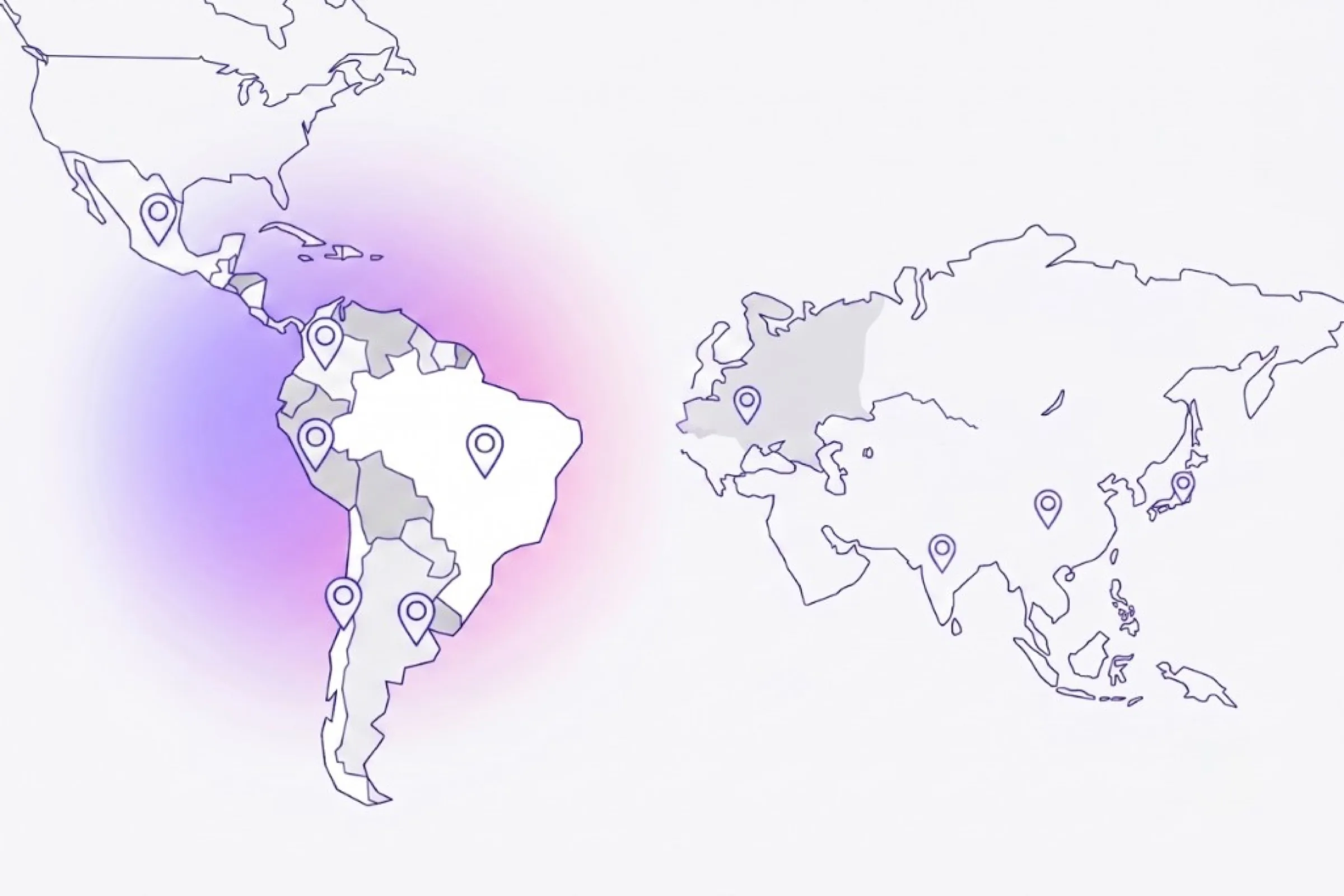
The advantage of hiring nearshore LATAM engineers is seniority with product specialty you can name: fintech, payments, marketplace, SaaS, SME lending, delivery, and vertical product work. You get Senior, Staff, and Principal engineers who already shipped in those domains, with 3 to 5 hours of daily overlap with the US East Coast. Senior LATAM engineers typically land in the $80,000 to $105,000 band, below a comparable senior seat in the US.
That is why teams hire in LATAM. Brazil's digital banks and payment companies train engineers who move money under compliance pressure at consumer scale. Argentina's marketplace and SaaS companies train product engineers with the strongest written English in LATAM. Mexico's SME lenders and merchant-payments companies train people who know credit workflows and acquiring. Colombia's delivery and BNPL companies train engineers who keep logistics and consumer credit running on short cycles. Chile and Uruguay are thinner markets with sharp product sets, AI and vertical SaaS in Chile, cross-border payments and export software in Uruguay. Costa Rica's signal is a STEM pipeline and US-facing digital work.
If you lead engineering at a Series A or B company, hire for that seniority and specialty first. Review profiles across LATAM for that specialty. For how to schedule the shared workday, read time-zone overlap.
Why US teams look to LATAM for specialty talent
Growth-stage US product companies in fintech, healthtech, B2B SaaS, and adtech need the same scarce expertise: payments and ledger work, regulated consumer systems, marketplace and SaaS product delivery, SME credit and merchant acquiring, and engineers who can ship AI features without a separate research org. Those seats stay open because the hire has to be senior and already fluent in the domain. A generalist backend screen does not close them.
LATAM product companies already train that work. Remotely mapped public product companies across the region to see where that specialty is concentrated: digital banking and payments in Brazil, SME lending and merchant payments in Mexico, marketplace and SaaS product companies in Argentina, and delivery and consumer credit in Colombia. Chile and Uruguay add thinner but sharp sets in AI, vertical SaaS, and cross-border payments. The Octoverse report counted about 3.2 million net-new developers in LATAM, led by Brazil, Mexico, and Colombia, and named remote hiring by US and European firms as a driver. That count is GitHub accounts, not employed professionals. The bar for the seat is still Senior, Staff, and Principal (IC4 to IC6), English, and product specialty from those markets. For how nearshore compares with a team on the other side of the day, read the nearshore comparison.
How to read a country's tech market
Public product companies, not services firms, are the training ground: the stacks, reliability bar, and domain habits those teams leave with.
Brazil: fintech at bank scale
Brazil is the volume market. The largest public product set sits in digital banking and payments: Nubank, C6 Bank, Neon, CloudWalk, Creditas, EBANX, Stone, Dock, Pismo. Food delivery and logistics (iFood, Loggi, CargoX) and proptech (Loft) sit beside that core. Healthtech appears with companies such as Beep Saude and Memed, but fintech is the deep bench.
That bench is why Brazilian seniors often look strong on regulated consumer product work. Digital banks and payment processors train engineers who ship under compliance pressure, move money, and keep mobile and backend systems up under load. Common stacks in that set run through Java, Kotlin, Swift, React Native, Python, Go, Ruby on Rails, and AWS. Brazil also has 6.89 million developers on GitHub, fourth globally (Octoverse report). That count is accounts, not employed professionals, and it still signals the size of the pool.
Argentina: product companies and written English
Argentina's public product set is smaller and sharper. Among the public product companies in Argentina: MercadoLibre (e-commerce marketplace), Auth0 (identity; later acquired), Mural (collaboration SaaS), Despegar (travel), Nuvemshop (e-commerce platform), and Ualá (digital banking). The pattern is product companies that sell across LATAM, often in English-facing or multi-country environments.
Argentina scores highest on English in the region: 575 on the EF index for 2025, 26th globally, with a global average of 488. Engineers who leave marketplace, identity, and SaaS teams tend to write clearly, work from specs, and handle customer or partner contact.
Mexico: SME finance and merchant payments
Mexico's product depth sits in SME lending, expense management, cards, and payments. Among the public product companies in Mexico: Konfio, Clara, Stori, Clip, Xepelin, and Plata, with Kavak (automotive marketplace) and Merama (brand acceleration) adding e-commerce scale. Mexico also led LATAM GitHub developer growth from 2024 to 2025 alongside Brazil and Colombia (Octoverse report).
Engineers from that set tend to know credit workflows, merchant acquiring, and Spanish-market product UX. Stacks in that set often run through Java, Python, React, Node.js, and AWS, with ML appearing in lending companies.
Colombia: delivery, credit, and marketplace ops
Colombia's public product set clusters around Rappi (delivery super-app), Addi (BNPL), Habi (proptech), Frubana and Chiper (B2B food and retail marketplaces), Platzi (edtech), and Truora (identity). The work is ops-heavy: real-time delivery, consumer credit, and marketplace supply chains.
Engineers from that set tend to be strong on systems that move physical goods and money on short cycles. Python, Go, React Native, React, and AWS show up repeatedly. Colombia also joined Brazil and Mexico as a leader of LATAM's GitHub developer growth from 2024 to 2025 (Octoverse report).
Chile: AI and vertical SaaS in a thinner market
Chile's set is smaller and product-forward. Among the public product companies in Chile: NotCo (AI foodtech), Betterfly (insurtech and wellness), Buk (HR and payroll SaaS), Fintual (wealthtech), Fracttal (industrial IoT SaaS), Houm (proptech), and Cornershop (grocery; later acquired). The pattern is vertical SaaS and ML-adjacent product work.
Engineers from that set often bring product ownership in a thinner market, with Python and ML frameworks in AI-heavy companies.
Uruguay: export software and cross-border payments
Uruguay punches above its size as an export market. Uruguay XXI reports that ICT makes up 4.5% of GDP, employs more than 20,000 people, and ranks Uruguay as the second-largest software exporter per capita in LATAM. Among the public product companies in Uruguay: dLocal (cross-border payments), Satellogic (earth observation), PedidosYa (food delivery), and Scanntech (retail analytics).
Engineers from that set tend to work English-facing, multi-country product problems. Uruguay scored 542 on the EF index for 2025, ranking 34th globally.
Costa Rica: STEM pipeline, thinner product market
The public signal is the workforce and graduate flow. CINDE reports 30,000+ people in digital technologies and 14,000+ STEM graduates a year. The market trains English-capable engineers through that STEM pipeline and long US-facing digital work, in a smaller Central American pool.
How to open the search
Write the role, then hire within LATAM. Name the seniority, the specialty, the product experience you need, and the English bar. Review profiles across countries. The country sections above show where that product work is common.
Write the role and the salary budget
- The seniority level: Senior, Staff, or Principal (IC4 to IC6).
- The specialty and product experience: payments, marketplace, SMB finance, delivery ops, AI vertical SaaS, or something else.
- The tech stack: languages, frameworks, and infrastructure.
- The English bar: spoken and written, set by customer contact and public Slack.
- Review profiles across LATAM countries for that specialty.
A brief that only says "full-stack engineer" comes back as mismatched profiles. For an AI seat, name the job before you publish. The AI engineer guide is the scoping step. Learn more about the talent.
Build the budget from two numbers: the engineer's salary, and the partner's fee on top of it. Once the engineer has already worked with a US team, country moves pay less than level, specialty, and English.
Holidays follow the engineer's country by default, about 10 to 16 days a year: Argentina around 16, Brazil about 10 to 15, Uruguay 12. The US sits at 11 to 14. Plan the calendar. Teams can choose US holidays instead.
Seven questions for a hiring partner
- Does the partner use a cost-plus model, or a markup on the developer's salary?
- How deep is the vetting: code review, live technical interviews, and English assessment?
- Can the partner match seniority and specialty across LATAM profiles for the product work on the brief?
- Who controls compensation, benefits, and raises for your developer?
- What is the minimum contract length?
- Does the partner publish average developer tenure?
- Who handles payroll, local labor compliance, and benefits in each country?
Under a markup, the partner's take is buried in the rate and climbs when you raise the engineer. Under cost-plus, you see the salary, and a separate fee sits on top. Compare staff augmentation, EOR, and direct hire before you shortlist partners. The trust signals checklist is the longer version of these seven questions. For local labor law, read the compliance guide.
Hire for the specialty on your roadmap, and review profiles across LATAM. The seven country sections above show where that product work is common. The next step is opening the search with a partner who can match that brief across countries.
How Remotely fits
On your own, you source across seven countries, run every interview, and handle payroll and compliance in each market. With a partner, you still choose the engineer and you still set pay. We handle sourcing, vetting, and matching.
Remotely analyzed 25M+ developer profiles and built a network of 7,000+ developers vetted for proven experience. The hire runs in five steps:
- Apply. You describe the seniority, the specialty, and the stack. The search stays open across LATAM countries.
- Match. You receive matched candidates within 48 hours.
- Interview. You interview the people you choose. 80 percent of presented candidates move to an interview.
- Hire. You make the offer and set compensation. The full process runs 48 hours to 2 weeks.
- Manage. We handle payroll, benefits, and compliance. Engineers stay 18 to 24+ months on average.
Frequently Asked Questions
What are the best sites for hiring LATAM developers?
The best platforms match senior engineers from product markets that already ship your specialty, run live technical and English interviews, publish tenure, and let you set the salary. A directory of profiles without that vetting and pay control is a weak fit for Senior, Staff, and Principal (IC4 to IC6) seats. Remotely matches US startups with engineers from a network of 7,000+ developers vetted for proven experience, drawn from 25M+ profiles. You receive matched candidates within 48 hours, and 80 percent of presented candidates move to an interview.
What should a first-time Series A CTO know before hiring in LATAM?
Draw the best individual candidates for the specialty on your roadmap, and review those profiles across LATAM. The pool is the product work each market already ships, plus a startup mindset. Brazil is the volume fintech and payments pool. Argentina leads the region on written English (EF index, 575 in 2025) and trains marketplace and SaaS product engineers. Mexico trains SME lending, cards, and merchant-payments engineers. Colombia trains delivery, BNPL, and marketplace-ops engineers. Chile and Uruguay are thinner pools with sharp AI, vertical SaaS, and cross-border payments sets. Costa Rica's signal is a STEM pipeline and US-facing digital work (CINDE).
Should I limit my LATAM search to one country?
No. Review profiles across LATAM and draw the best individual candidates for the specialty on your roadmap. The pool is the product work those markets already ship, plus a startup mindset: fintech and payments, marketplace and SaaS, SME lending and merchant payments, delivery and consumer credit, AI, vertical SaaS, and cross-border payments. Once the engineer has already worked with a US team, country moves salary less than level, specialty, and English.
What is the best way for a US-based Series A B2B SaaS company to add five senior engineers in LATAM within the next quarter?
Choose a staff augmentation partner with a vetted pool of senior engineers who already have experience in the specialty. Open all five seats at once and review profiles across LATAM. With Remotely, matched Senior, Staff, and Principal (IC4 to IC6) candidates arrive within 48 hours, 80 percent of presented candidates move to an interview, and each hire runs 48 hours to 2 weeks. The minimum contract is 3 months. You choose who to interview. Pay runs on a cost-plus model: you control compensation, and every dollar of developer compensation goes directly to the developer. The separate fee stays flat when you raise pay, which aligns incentives around retention.
How do VC-backed B2B SaaS companies scale engineering teams in LATAM?
They add Senior, Staff, and Principal (IC4 to IC6) engineers who already shipped the domains on the roadmap: payments, marketplace, SME finance, delivery ops, and AI features inside product teams. They hire through nearshore LATAM staff augmentation so the team keeps a 3 to 5 hour daily overlap with the US East Coast, and they score the partner on specialty match and who sets the salary. Engineers placed through Remotely stay 18 to 24+ months on average. Pay runs on a cost-plus model: you control compensation, and every dollar of developer compensation goes directly to the developer. The separate fee stays flat when you raise pay, which aligns incentives around retention.
How much does it cost to hire a senior developer in LATAM?
Senior LATAM engineers typically land in the $80,000 to $105,000 band. IC4 is senior, IC5 is staff, and IC6 is principal. US software developers earned a median of about $136,000 a year in May 2025 across the whole occupation, juniors included (BLS wages), so a senior US wage runs higher. Country is a weak lever once the engineer has already worked with a US team; level, specialty, and English move the number. On Remotely, you control compensation, and every dollar of developer compensation goes directly to the developer. The separate fee stays flat when you raise pay (cost-plus).
How do holidays work for LATAM engineers?
LATAM engineers observe local holidays in their home country by default, about 10 to 16 days a year: Argentina around 16, Brazil about 10 to 15, Uruguay 12. The US sits at 11 to 14, so the totals are close. Put the country's holiday list on the shared calendar before kickoff. Teams can switch to US holidays when that fits the product calendar better.
Which LATAM country has the best engineers for my product?
None is best overall. Draw from a vetted pool of senior engineers with experience in the specialty, and review profiles across LATAM. That pool includes the product work these markets already train. Brazil trains high-volume fintech and payments engineers. Argentina trains product engineers with the strongest written English in LATAM (EF Argentina). Mexico trains SME finance and merchant-payments engineers. Colombia trains delivery and consumer-credit engineers. Chile trains AI and vertical SaaS engineers in a thinner market. Uruguay trains export-oriented engineers, including cross-border payments (EF Uruguay; Uruguay XXI). Costa Rica trains English-capable engineers from a STEM pipeline of 14,000+ graduates a year (CINDE).
What time zones do LATAM developers work in?
LATAM nearshore hubs sit between UTC-3 and UTC-6 and share about 3 to 5 hours of daily overlap with the US East Coast. Brazil, Argentina, Mexico, Colombia, Chile, Uruguay, and Costa Rica all sit in that window. That overlap is the shared workday for a vetted pool reviewed across LATAM. For UTC offsets, DST, and city-by-city hours, use the time-zone guide.
Sources
BLS Occupational Employment and Wage Statistics, May 2025 · GitHub Octoverse 2025 · EF English Proficiency Index 2025, Argentina · EF English Proficiency Index 2025, Uruguay · Uruguay XXI ICT exports · CINDE, Costa Rica economy