.svg)
.svg)


Last updated: February 2026
Latin America spans four major time zones, from UTC-3 (Argentina, Brazil) to UTC-6 (Mexico, Costa Rica, Guatemala). Most LATAM countries overlap 6-8 hours with the standard US business day. Colombia, Peru, and Ecuador match US Eastern Standard Time exactly at UTC-5. Mexico and Central American countries align with US Central Time at UTC-6. Brazil and Argentina (UTC-3) overlap with US East Coast morning hours. This guide maps every major LATAM country to its US time zone equivalent, with overlap hours for remote engineering teams.
Time zones play a critical role in remote team collaboration. This guide maps the connections between Latin American and US time zones -- and explains why that alignment gives LATAM a significant advantage for US companies building remote engineering teams.
Time Zone Connections: Latin America and the US
Latin America and the US share more time zone overlap than most people realize. Let’s start with two key US time zones: Pacific and Central.
Exploring the Time Zones: US Pacific and Central
In California on Pacific Time, while your amigos in Mexico City are already two hours ahead and thinking about lunch. It’s all thanks to the US Pacific Time Zone, which stretches its warm embrace along the western coast of the United States.
Just a hop, skip, and a jump away lies the US Central Time Zone. With its sprawling plains, vibrant cities, and rich cultural heritage, it’s a melting pot of American and Latin American traditions. And let’s not forget our Latin American neighbors in countries such as Honduras, Guatemala, and Costa Rica, who also share this same UTC-6 offset year-round.
Imagine standing on the sandy beaches of Acapulco, Mexico, with the Pacific Ocean stretching out before you. As the waves crash against the shore, you can’t help but feel a sense of tranquility and wonder. Despite sitting on the Pacific coast, Acapulco actually runs on Central Time (UTC-6), the same as Mexico City. Meanwhile, in the US Pacific Time Zone, the bustling city of Los Angeles comes alive with its vibrant culture and entertainment scene. From Hollywood to Venice Beach, there’s never a dull moment in this time zone.
Now, let’s venture into the US Central Time Zone. As you explore the heartland of America, from the jazz clubs of New Orleans to the barbecue joints of Kansas City, you’ll encounter a rich tapestry of culture and cuisine. And as you travel further south, you’ll find yourself in the heart of Central America, where countries like Honduras and Guatemala captivate visitors with their rich history and vibrant traditions.
Latin American Countries in the US Central Time Zone
Now, let’s take a closer look at more Central Time connections. Here, you can find our Latin American friends from El Salvador, Nicaragua, and the western Yucatán Peninsula states of Yucatan and Campeche in Mexico. Imagine the vibrant conversations and pulsating energy that flows through the air when these colorful cultures collide.
As you journey through the US Central Time Zone, you’ll discover the charming city of San Antonio, Texas, with its blend of Mexican and Texan influences. The Alamo, a historic landmark, stands as a testament to the region’s rich history. Further south, you’ll find yourself in Mexico’s Yucatán Peninsula, home to the ancient Mayan ruins of Chichen Itza in the state of Yucatan. Note that the state of Quintana Roo -- home to the stunning beaches of Cancún -- actually runs on Eastern Standard Time (UTC-5), one hour ahead of its peninsular neighbors. And let’s not forget about El Salvador and Nicaragua, two countries that boast beautiful landscapes, vibrant markets, and warm-hearted locals.
Latin American Nations in the US Eastern Time Zone
Last but certainly not least, we have the legendary US Eastern Time Zone. Alongside iconic cities like New York and Washington D.C., we find Colombia, which shares the same UTC-5 offset as Eastern Standard Time year-round. Nearby in the Caribbean, countries such as the Dominican Republic and Puerto Rico operate on Atlantic Standard Time (UTC-4), which is one hour ahead of EST. During the summer months, when the US East Coast shifts to Eastern Daylight Time (UTC-4), these Caribbean destinations align perfectly with cities like New York and Miami.
Imagine strolling through the colorful streets of Old San Juan, Puerto Rico, where Spanish colonial architecture meets Caribbean flair. The rhythmic beats of salsa music fill the air as locals and tourists alike dance the night away. In the Dominican Republic, you can soak up the sun on the pristine beaches of Punta Cana or explore the historic capital city of Santo Domingo, a UNESCO World Heritage site.
As you venture further south, you’ll find yourself in Colombia, a country known for its vibrant culture, stunning landscapes, and warm hospitality. From the bustling streets of Bogota to the colonial charm of Cartagena, there’s something for everyone in this diverse nation.
The US Eastern Time Zone not only connects Latin America with iconic American cities but also serves as a gateway to the Caribbean, where paradise awaits. Whether you’re exploring the vibrant streets of New York City or basking in the tropical beauty of Puerto Rico, the time zone connections between Latin America and the US East Coast add an extra layer of excitement and cultural exchange to this already captivating region.
Syncing Time Zones: South American Countries and the US
Prepare to be amazed as we dive into the mystical realm of South America and its unique connection with the US time zones, blending cultures and bridging time gaps like never before!
South America, the land of vibrant colors, rich history, and diverse cultures, is home to twelve countries that span across multiple time zones. From the tropical rainforests of Brazil to the breathtaking landscapes of Argentina, this continent is a true marvel. But what makes it even more fascinating is its intricate relationship with the time zones of the United States.
Let’s start our journey in Brazil, the largest country in South America. As we move from the westernmost state of Acre, which shares the same UTC-5 offset as Eastern Standard Time, to the eastern state of Amapá on Brasília Time (UTC-3), which is two hours ahead of EST, we witness the breadth of Brazil’s four time zones. This range of time offsets allows for overlapping business hours with the US, facilitating trade, tourism, and cultural exchanges.
Heading further south, we arrive in Argentina, a country known for its passionate tango and delicious steak. Argentina is two hours ahead of EST at UTC-3, which means that when it’s noon in Buenos Aires, it’s only 10 am in New York. This time difference has its advantages, especially for businesses that operate across both countries. It allows for extended working hours and ensures that there is always someone available to assist customers or partners on either side of the continent.
Continuing our exploration, we find ourselves in Chile, a country that stretches along the western edge of South America. Chile uses UTC-3 in summer and UTC-4 in winter, placing it two to three hours ahead of Eastern Standard Time. This means when it’s 9 am in Washington, D.C. during US winter, it’s already 11 am in Santiago. This time difference may seem modest, but with Chile being ahead, it opens up a world of possibilities for collaboration and cooperation between the US and Chile. With careful planning and effective communication, businesses and organizations can bridge this time gap and work together seamlessly.
As we venture north, we encounter Colombia, a country known for its vibrant culture and warm hospitality. Colombia operates at UTC-5, the same offset as Eastern Standard Time, which means that when it’s 10 am in Miami, it’s also 10 am in Bogotá. This seamless time alignment has helped Colombia and the US develop strong economic ties, with trade between the two countries reaching billions of dollars each year. This connection is a testament to the power of geographic proximity and the ability to collaborate in real time across borders.
Our journey through South America would not be complete without a visit to Peru, a country that boasts ancient ruins, breathtaking landscapes, and a rich cultural heritage. Peru is aligned to Eastern Standard Time (EST) at UTC-5, which means that when it’s 1 pm in New York City, it’s also 1 pm in Lima. The only difference is that Peru does not observe daylight saving time, so when the U.S. shifts to Eastern Daylight Time (EDT) in summer, Peru is one hour behind the U.S. East Coast.As we conclude our exploration of South America’s connection with the US time zones, we are left in awe of the intricate dance between continents. The synchronization of time zones has not only facilitated communication and cooperation but has also fostered a sense of global interconnectedness. It reminds us that despite our geographical distances, we are all part of a larger world, where time knows no boundaries.
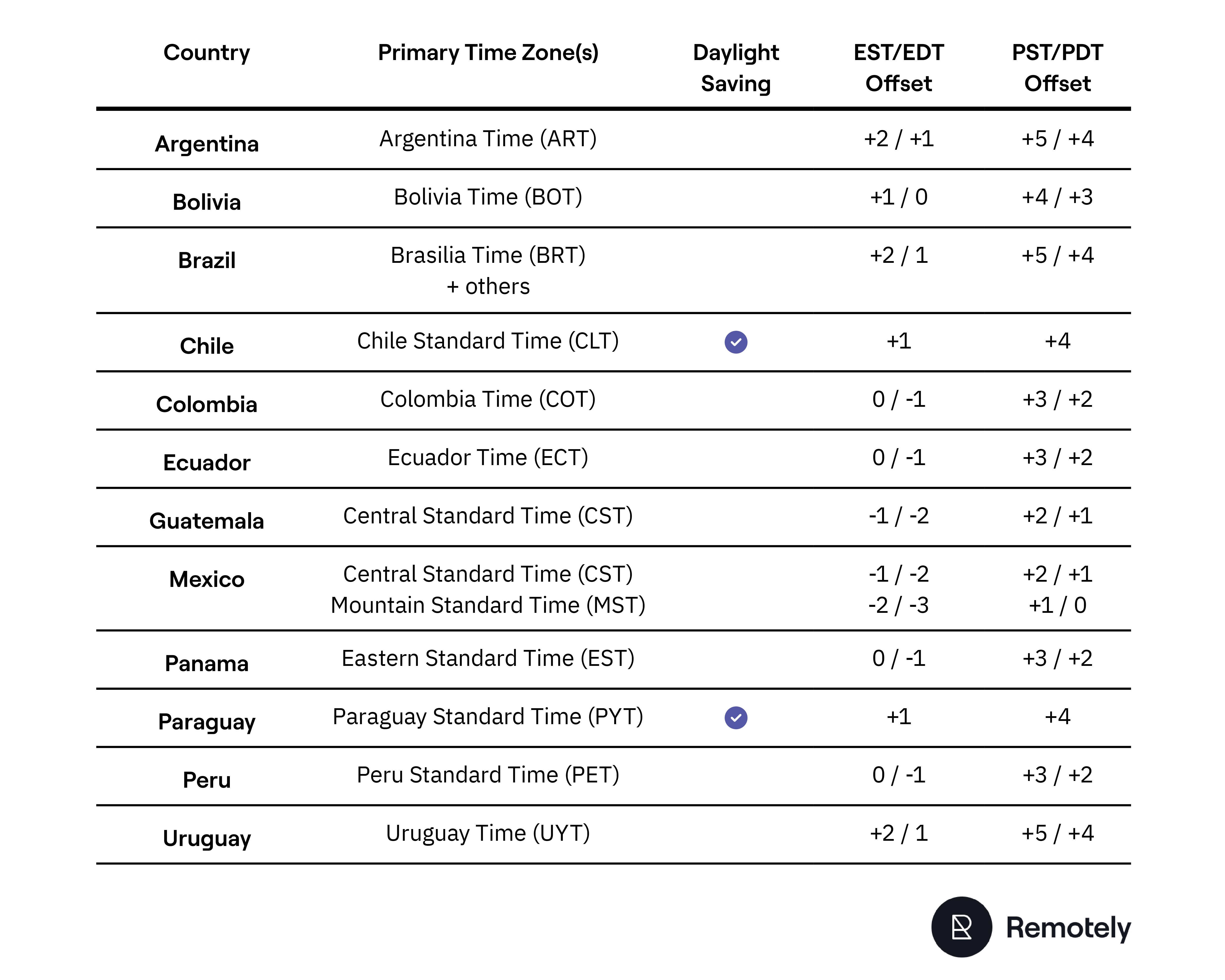
Time Zone Overlap by Country: Latin America and the US
The table below maps every major LATAM country to its UTC offset and shows how many working hours overlap with US Eastern and Pacific time zones.
Leveraging Latin American Talent in US Time Zones for Remote Teams
In this fast-paced world, remote work has become the norm, and the possibilities are endless. In this section, we’ll explore the advantages of working with Latin American talent in US time zones and how it can revolutionize the way we collaborate across borders. Get ready for some mind-blowing insights!
Collaborating Across Borders: Working Hours Alignment with Latin American Teammates
You’re working on a project, sipping your morning coffee in New York, while your talented counterpart in São Paulo is already a couple of hours into her workday. Together, you form an unstoppable duo that defies time constraints and crosses cultural boundaries.
Expanding Your Talent Pool Globally with Synchronous Collaboration
Why limit yourself to local talent when you can cast your net wider? By embracing Latin American talent in US time zones, you open up a world of possibilities. The cultural diversity and fresh perspectives that arise from this collaboration are like a breath of fresh air in a stuffy office. Prepare to embark on an international talent hunt!
Embracing Cultural Similarity for Enhanced Team Dynamics
Have you ever experienced the magic of bonding with someone from a different culture? It’s like discovering a secret sauce that adds an extra kick of flavor to any collaboration. By working with Latin American talent in US time zones, you’ll not only find cultural similarities but also embrace the delightful differences that make teamwork truly extraordinary.
Competitive Compensation Advantage Outside the US
Last but definitely not least, let’s talk about that ever-elusive topic: compensation. Working with Latin American talent in US time zones offers a unique advantage. The cost of living in Latin America is often lower than in the US, allowing you to attract top-notch talent without breaking the bank. With a transparent, cost-plus staffing model, you see exactly what developers earn and what you pay — no hidden markups.
Simplifying the Process: Source, Hire, and Pay Latin American Developers with Remotely
Now that we’ve explored the wonders of time zone alignment and international collaboration, it’s time to simplify the process. Whether you’re evaluating staff augmentation, EOR, or direct hire, the first step is understanding which model fits your team. Remotely is built for growth-stage startups scaling engineering teams across LATAM — with transparent pricing and a cost-plus model.
Remote Software Developer Hiring Made Easy
With Remotely, finding your dream team is easy. Our platform connects you with a vast pool of talented Latin American developers, ensuring a seamless hiring process that will make your competitors green with envy!
Ready to tap into the rich pool of Latin American software development talent and align your team’s productivity with US time zones? Look no further than Remotely Works, the transparent and trusted marketplace that not only helps you hire senior developers but ensures their success and retention in your company. Experience the value of a truly symbiotic partnership where transparency leads to maximized potential for both your company and your developers. Don’t let time zones limit your team’s capabilities—hire developers through Remotely Works and watch your projects thrive.
Frequently Asked Questions
What LATAM countries are in the same time zone as the US?
Colombia, Peru, Ecuador, and Panama share the same UTC-5 offset as US Eastern Standard Time. Mexico, Guatemala, Honduras, El Salvador, Nicaragua, and Costa Rica match US Central Time at UTC-6. During US daylight saving time, the offsets shift by one hour for US-based zones, while most LATAM countries do not observe DST.
How many hours of overlap do LATAM developers have with US teams?
Most LATAM countries overlap 6-8 hours with the US business day. Countries at UTC-5 (Colombia, Peru, Ecuador) have full overlap with US Eastern Time. Countries at UTC-6 (Mexico, Costa Rica) overlap fully with US Central Time. Brazil and Argentina (UTC-3) typically overlap 6 hours with the US East Coast, covering the morning and early afternoon.
Does Latin America observe daylight saving time?
Most LATAM countries do not observe daylight saving time. Brazil eliminated DST in 2019. Argentina, Colombia, Peru, Ecuador, and all Central American countries use fixed UTC offsets year-round. Chile and Paraguay are exceptions -- both observe DST, but on the opposite schedule from the US (their summer is the US winter). Mexico reformed its DST policy in 2022; most states no longer observe it, though border cities follow US DST rules.
What is the best LATAM country for time zone alignment with the US East Coast?
Colombia and Peru offer the best alignment with the US East Coast. Both operate at UTC-5 year-round, matching Eastern Standard Time exactly. During US daylight saving time (March-November), they are one hour behind EDT. For teams that need full real-time overlap during US business hours, Colombia and Peru provide the most seamless alignment.
What is the time difference between Brazil and the US?
Brazil’s primary time zone (Brasília Time, UTC-3) is 2 hours ahead of US Eastern Standard Time and 5 hours ahead of US Pacific Time. When the US shifts to daylight saving time, the gap widens by one hour (Brazil does not observe DST). Western Brazilian states like Acre use UTC-5, matching US Eastern Standard Time.
Can LATAM developers work US business hours?
Yes. Developers in UTC-5 countries (Colombia, Peru, Ecuador) can work standard US Eastern business hours with no adjustment. Developers in UTC-6 countries (Mexico, Costa Rica) align with US Central Time naturally. Developers in Brazil and Argentina (UTC-3) typically work 8am-4pm or 9am-5pm local time to overlap with US East Coast mornings, which still provides 6+ hours of real-time collaboration.
Why do US companies hire remote developers in Latin America instead of other regions?
Time zone alignment is the primary advantage. LATAM developers can collaborate with US teams in real time during business hours, which is not possible with offshore teams in India or the Philippines (10-12 hour difference). Beyond time zones, LATAM offers strong English proficiency, cultural alignment with US business norms, competitive compensation rates (40-60% below US market rates for equivalent seniority), and a growing startup ecosystem that produces developers familiar with modern tech stacks. For US companies building remote engineering teams through staff augmentation platforms that prioritize transparency, the combination of real-time overlap and deep talent pools makes LATAM the default choice.