.svg)
.svg)


Most US growth-stage startups hiring remote engineers in LATAM face a significant misclassification risk, often triggered during offboarding and capable of escalating into six-figure compliance liabilities. This risk is widely misunderstood and rarely addressed by common hiring platforms. This article defines the risk, identifies the countries where it is most relevant, and explains how Remotely's Agent of Record model eliminates it from day one.
If you are evaluating nearshore LATAM talent, in due diligence on a staffing partner, or preparing a compliance case internally, this guide covers the ground you need: what misclassification is and why LATAM triggers it specifically, how the legal exposure differs across Brazil, Mexico, Argentina, and Colombia, how the model is structured to eliminate that exposure, and the compliance questions you should be asking any staffing partner before you sign.
What is contractor misclassification, and why does it hit LATAM hiring specifically?
Contractor misclassification happens when a worker hired as an independent contractor is later reclassified as a full employee by a local labor court, triggering retroactive back-payment of taxes, benefits, and severance. In LATAM, this risk is structurally higher than in the US because local labor laws presume employment when certain conditions exist.
The conditions that trigger reclassification in LATAM are different from US standards. A US-style contractor relationship (single client, fixed hours, startup-provided equipment, full-time engagement) is precisely the pattern that labor courts in Brazil, Argentina, Mexico, and Colombia use to reclassify a contractor as an employee. Sending a US-standard contractor agreement to a LATAM developer does not protect you under local law.
The key point: geography determines legal exposure. The same hiring structure that is perfectly legal in the US can create six-figure retroactive liability in Brazil or Argentina.
Which LATAM countries carry the highest misclassification risk?
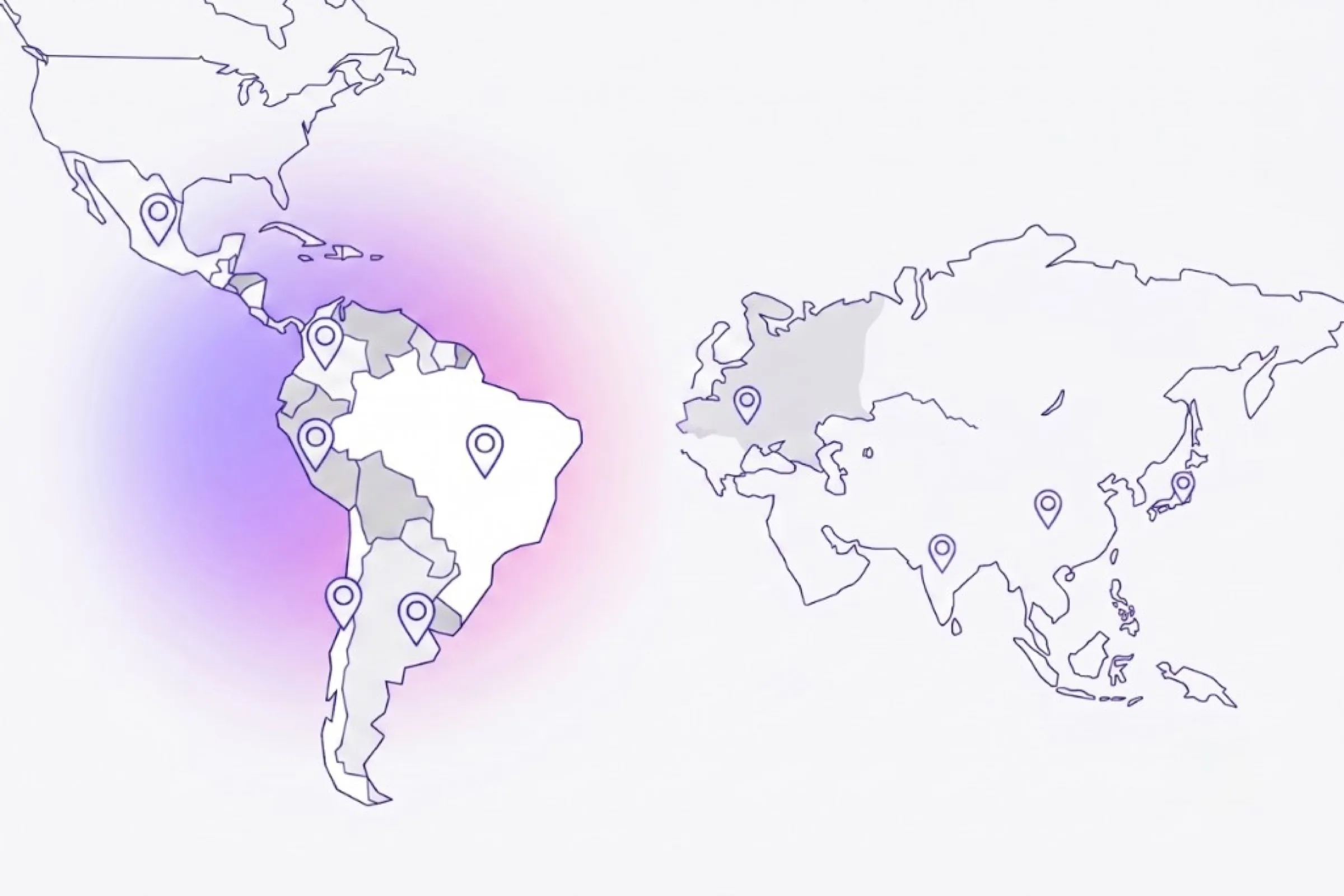
Brazil, Argentina, Mexico, and Colombia each carry significant misclassification risk, but the specific triggers, financial exposures, and legal frameworks differ by country. Understanding each one is the first step to structuring a compliant engagement.
Brazil: CLT (Consolidação das Leis do Trabalho)
Brazil carries the highest misclassification risk of any LATAM country. Under the CLT (Consolidação das Leis do Trabalho), Brazil's federal labor code, courts presume an employment relationship when a contractor has a single income source, works fixed hours, and operates under the direct supervision of the client startup.
A successful reclassification claim in Brazil triggers retroactive FGTS contributions (8% of all salary paid), 13th-month salary (one full month's pay per year), mandatory vacation pay with a one-third premium, and INSS social security contributions. In a three-year engagement, that retroactive exposure can exceed $50,000 USD for a single engineer.
The key point: Brazil's CLT is one of the strongest worker-protection frameworks in the world, and it applies regardless of what your contract says.
Mexico: LFT (Ley Federal del Trabajo)
Under Mexico's Ley Federal del Trabajo, a contractor is considered an employee if they work exclusively for one startup, are economically dependent on that startup, and perform work that is part of the startup's core business activity. Mexico's 2021 labor reform (reform to the LFT) tightened subcontracting rules significantly. Staffing providers must now register with REPSE (Registro de Prestadoras de Servicios Especializados u Obras Especializadas) to legally provide outsourced workers.
Misclassification in Mexico triggers retroactive IMSS contributions, INFONAVIT housing fund payments, profit-sharing obligations (PTU), and aguinaldo (mandatory annual bonus).
The key point: post-2021, Mexico has zero tolerance for informal outsourcing structures, and REPSE registration is non-negotiable for any compliant staffing arrangement.
Argentina: LCT (Ley de Contrato de Trabajo)
Argentina's LCT (Ley de Contrato de Trabajo) presumes an employment relationship in almost all circumstances where work is performed on a regular, continuous basis for compensation. Argentine labor courts have historically ruled in favor of workers in classification disputes, making it one of the highest-risk jurisdictions for informal contractor engagements.
Reclassification in Argentina triggers indemnización (severance calculated at one month's best salary per year of service, with a minimum of two months), plus retroactive social security contributions, vacation pay, and sick leave accrual. Argentina's regulatory environment also changes with administrations, making it critical to work with a partner that tracks local law in real time.
The key point: in Argentina, the safest assumption is that a long-term, single-client contractor relationship will eventually be challenged.
Colombia: Código Sustantivo del Trabajo
Colombia is the fastest-growing engineering hub in LATAM and carries a compliance risk that most startups underestimate precisely because it is newer and less discussed. Under the Código Sustantivo del Trabajo (Decreto 2663 de 1950), misclassification triggers retroactive parafiscal contributions: mandatory payments to SENA (vocational training), ICBF (family welfare), and Cajas de Compensación Familiar (family compensation funds).
Colombian labor law also provides for retroactive severance (cesantías), interest on cesantías, and prima de servicios (semi-annual bonus payments).
The key point: Colombia's rapid growth as an engineering destination has not been matched by US startups' awareness of its compliance requirements, creating a gap that is increasingly being litigated.
How does Remotely's model eliminate this risk?
Remotely is a staff augmentation platform that operates as the Agent of Record for every engagement. This is the structural mechanism that eliminates misclassification exposure for US client startups: the US client startup never enters into a direct contract with the LATAM developer. Instead, every developer signs a Professional Services Agreement with Remotely Works, Inc., a Delaware corporation. Remotely then provides those services to the client startup under a separate services agreement.
This structural intermediation is the foundation. Because the US client has no direct contractual relationship with the LATAM developer, the legal basis for a misclassification claim against the US startup does not exist. The developer's relationship is with Remotely, a US entity. Any compliance questions under local labor law run through that relationship, not through the client.
The model addresses the remaining risk vectors in four ways.
Transparent cost-plus payroll
The cost-plus model means you see the engineer's salary, you set the compensation, and there is no hidden agency margin. Every dollar of the developer's salary goes directly to the developer. Remotely charges a management fee per developer that covers payroll, compliance, PTO tracking, equipment procurement, and retention operations: typically $2,000/month for salaries above $50,000/year, and $1,000/month for salaries below that threshold. Volume discounts apply for larger teams.
This structure matters legally because opacity in the compensation relationship is itself a misclassification risk signal when startups contract developers directly. Courts look at who controls compensation as one of the primary factors in determining employment status. The client sets compensation directly, the developer is paid monthly in USD through a dedicated payroll infrastructure, and every transaction is documented.
In summary: the cost-plus model is not just fair pricing. It is also a documented, transparent compensation structure with a clear legal record.
Explicit IP assignment
The Professional Services Agreement between Remotely and each developer includes a work-made-for-hire provision and an explicit IP assignment covering all materials, source code, design work, documentation, and derivative works produced as part of the engagement. This clause is signed before any work begins. IP ownership transfers completely to Remotely for the benefit of the client startup from the first day of engagement.
In summary: IP ownership is never ambiguous when you hire through Remotely. It is explicitly assigned before work begins.
Compliant offboarding
Termination is the moment misclassification claims most commonly surface, and it is the step most startups handle incorrectly. Every offboarding is handled with proper termination documentation, final payment calculations, and signed termination agreements. Security deposits are held by Remotely throughout the engagement specifically to cover termination payments.
The termination payment schedule is defined contractually in the client's Order Form: from $0 for the first 3 months (mimicking employment-at-will) to a capped maximum of 2 months' contractor services rate for longer tenures. Termination payments may be reduced or waived in cases of documented performance issues or misconduct.
In summary: the engagement ends with full documentation and defined financial obligations, without creating the retroactive liability that informal terminations typically trigger.
Agent of Record structural intermediation
The core protection: your startup never contracts directly with LATAM developers through Remotely. You sign a services agreement with Remotely Works, Inc. The developer signs a Professional Services Agreement with Remotely Works, Inc. Remotely serves as the Agent of Record, handling payroll, compliance, PTO, equipment procurement, and contractor lifecycle management.
This is different from an Employer of Record (EOR) model, where the EOR employs the developer as a formal local employee (which adds statutory employment costs of 30 to 40%+ in countries like Brazil (varies by country)). The AOR model structures the developer as an independent contractor of a US entity, keeping costs down while removing direct misclassification exposure from the US client startup.
In summary: the compliance structure works because your startup's legal relationship is with Remotely, not with the LATAM developer.
What about HIPAA, SOC II, and regulated industries?
US growth-stage startups building in HealthTech, FinTech, or enterprise SaaS with strict compliance postures often ask whether hiring international engineers creates a gap in their regulatory framework. The direct answer is no, but the reasoning matters.
HIPAA governs how your organization handles Protected Health Information (PHI). It applies to your systems, your access controls, your policies, and your people, regardless of where those people are located. An engineer hired through Remotely in Colombia is subject to the same HIPAA obligations as an engineer in Austin: your internal access control policies, your BAA obligations with vendors, and your security training requirements.
The key point: HIPAA compliance is determined by your data handling practices, not by your engineer's geography.
SOC II audits evaluate your organization's security controls across five trust service criteria: security, availability, processing integrity, confidentiality, and privacy. Auditors look at role-based access control, audit logging, background verification, and documented security training. Engagements structured this way support your SOC II posture by providing properly documented contractor agreements, a clear legal record of the engagement relationship, and confidentiality obligations that are part of every contractor agreement.
In summary: hiring through Remotely does not create a SOC II gap. A gap in your own access policies does.
For growth-stage startups building in regulated industries, the recommended baseline is: startup-provisioned or MDM-enrolled devices, VPN access to all internal systems, MFA on all production tooling, and explicit confidentiality obligations in the engineer's contract, all of which can be structured as part of the engagement agreement.
The four compliance questions to ask any nearshore staffing partner
Before signing with any nearshore staffing firm, including Remotely, ask these four questions. The answers will tell you immediately whether your legal exposure is being handled or ignored.
1. Who is the legal counterparty: your startup or the staffing firm?If the developer signs a contract directly with your startup, the misclassification risk lands on you. If the developer contracts with the staffing firm (as they do with Remotely), the structural intermediation removes direct liability from your startup. This is the single most important structural question.
2. Is IP assignment explicit, signed before work begins, and clearly documented?Verbal agreements and implied work-for-hire do not provide reliable protection. The assignment should be written, signed, and in place before the first line of code is committed.
3. Do I see the engineer's actual salary, or do you quote me a total fee?Opacity in compensation is a red flag for any compliant engagement structure and is itself a misclassification risk signal when the relationship is structured correctly. A cost-plus model with full salary transparency is the standard to require.
4. How do you handle termination, and what documentation do you provide?If the answer is vague, the offboarding risk is yours. A compliant partner can answer this specifically: defined notice periods, final payment calculations, and signed termination documentation.
In summary: a compliant partner can answer all four of these questions specifically and immediately.
Get the compliance structure right before you hire
Getting the compliance structure right is part of getting the hire right. The engineer's qualifications and the legal scaffolding underneath the engagement are not separate decisions.
If you want to see how this plays out in the real world, explore our customer stories to see how growth‑stage startups from health tech to fintech expanded their engineering teams into LATAM while staying fully compliant with Remotely as their hiring partner. These customer stories show how companies relied on Remotely to handle compliance, payroll, and contractor relationships so they could avoid misclassification risk and maintain clean, defensible headcount across regions.
Frequently asked questions
What is contractor misclassification in the context of LATAM hiring?
Contractor misclassification occurs when a worker engaged as an independent contractor is reclassified as a full employee by a local labor court. In LATAM, this triggers retroactive payment of taxes, social security contributions, benefits, and severance. Brazil, Argentina, Mexico, and Colombia all have labor codes that presume employment when certain conditions (like exclusivity, fixed hours, or economic dependence) are present in the working relationship. Remotely eliminates this exposure at the structural level: your startup never contracts directly with the LATAM developer, so the legal basis for a misclassification claim against you does not exist.
Which LATAM countries have the highest misclassification risk for US growth-stage startups?
Brazil carries the highest risk due to CLT protections that are broadly applied by labor courts. Argentina follows closely, with its LCT presuming employment in nearly all continuous working relationships. Mexico's 2021 LFT reform tightened subcontracting rules significantly, requiring REPSE registration. Colombia is an emerging risk as its engineering sector grows faster than US startups' awareness of local labor law requirements.
Remotely sources and manages engineers across all four of these countries through its Agent of Record model.
Can I send a US-standard contractor agreement to a developer in Brazil or Argentina?
No. A US-standard contractor agreement does not provide legal protection under Brazilian CLT or Argentine LCT. Local labor courts evaluate the substance of the working relationship, not the contract label. If the relationship has the characteristics of employment (exclusivity, fixed hours, equipment provision, single income source), a US contract will not prevent reclassification. With Remotely, this problem is structural: the developer contracts with Remotely Works, Inc., a US entity, not with your startup.
What retroactive liabilities does misclassification trigger in Brazil?
Misclassification in Brazil triggers retroactive FGTS contributions (8% of all salary paid), 13th-month salary (one full month per year of service), mandatory vacation pay with a one-third premium, and INSS social security contributions. For a three-year engagement at a $5,000/month salary, total retroactive exposure can exceed $50,000 USD.
How does Remotely eliminate contractor misclassification risk?
Remotely operates as the Agent of Record for every engagement. The US client startup never contracts directly with the LATAM developer. The developer signs a Professional Services Agreement with Remotely Works, Inc., a Delaware corporation. This structural intermediation means the legal basis for a misclassification claim against the US startup does not exist through this arrangement. Remotely handles payroll, compliance, PTO, equipment procurement, and lifecycle management under a transparent cost-plus model: a management fee of typically $2,000/month per developer for salaries above $50,000/year, and $1,000/month for salaries below that threshold. Every dollar of the developer's salary goes directly to the developer. A separate security deposit is held by Remotely and returned at the end of the engagement. Every engagement is structured this way from day one, with no exceptions.
Who owns the IP for code written by a Remotely engineer?
All intellectual property, including code, design, documentation, and derivative works, is assigned to Remotely Works through an explicit work-made-for-hire clause in every contractor agreement, and flows through to the client startup. This clause is signed before any work begins. IP ownership is never ambiguous or implied. It is explicitly assigned from the first day of engagement. It is built into every contractor agreement as a non-negotiable term, before a single line of code is written.
Can a HIPAA-compliant startup hire nearshore LATAM engineers through Remotely?
Yes. HIPAA compliance is determined by your organization's data handling practices, access controls, and internal policies, not by where your engineers are located. An engineer hired through Remotely in Colombia or Brazil is subject to the same HIPAA obligations as any domestic team member. What matters is that you apply proper access controls, BAA obligations with relevant vendors, and security training requirements consistently across your team. Remotely can structure confidentiality obligations and security protocol acknowledgments covering PHI handling as part of every engagement agreement.
Does hiring international engineers through Remotely affect SOC II compliance?
No. SOC II audits evaluate your security controls, not your employment model. Remotely-structured engagements support your SOC II posture by providing properly documented contractor agreements, confidentiality obligations in every contractor PSA, and a clear legal record of the engagement relationship. Auditors look for role-based access control, audit logging, and documented security training, all governed by your internal policies, not by the engineer's country of residence. Every engagement produces the documented contractor agreement and legal record that auditors want to see.
What is Mexico's REPSE requirement and does it affect hiring through Remotely?
Mexico's 2021 LFT reform requires any staffing provider offering specialized outsourced workers to register with REPSE (Registro de Prestadoras de Servicios Especializados u Obras Especializadas). Operating without REPSE registration creates tax and labor liability for both the staffing provider and the client startup. With Remotely, Mexico engineers contract directly with Remotely Works, Inc., a US entity, which limits your startup's direct exposure under the LFT subcontracting rules.
What security practices should we require from LATAM engineers working on sensitive products?
For engineers working on regulated or sensitive products, require: startup-provisioned or MDM-enrolled devices, VPN access to all internal systems, MFA on all production tooling, no local storage of sensitive data, and completion of annual security awareness training. Remotely can structure explicit confidentiality obligations, security protocol acknowledgments, and NDA terms covering regulated data handling as part of the engagement agreement, so these requirements are contractually binding before the engineer's first day.
Sources
CLT, Presidência da República · LFT reform, Diario Oficial de la Federación, April 23 2021 · REPSE registration portal, STPS · LCT, InfoLEG (Ley 20.744) · Ministerio de Trabajo, Empleo y Seguridad Social, Argentina · Código Sustantivo del Trabajo, Función Pública (Decreto 2663 de 1950) · Ministerio del Trabajo de Colombia · ILO World Employment and Social Outlook 2023