.svg)
.svg)


US startups, scale-ups, and mid-market technology companies augmenting their engineering teams face a version of this decision at nearly every growth stage: nearshore or offshore? The choice is not primarily about geography. It is about how your product development model interacts with time zones, communication patterns, talent availability, and risk tolerance. This guide explains the structural differences between the two models, shows where each performs best, and gives engineering leaders a practical framework for deciding, including the case for and against LATAM versus India or Eastern Europe at the Series A, B, and C stages and beyond.
What staff augmentation is (and is not)
Staff augmentation is a remote hiring model where a startup adds external professionals who work as embedded members of the internal team, following the company's tools, backlog, and development standards. The startup retains ownership of priorities and daily management. This is different from traditional outsourcing, where an entire project is handed off to a vendor that owns delivery and executes independently with limited day-to-day input from the company.
The operational implication matters: staff augmentation requires a functioning product team that can direct, review, and integrate the work of augmented engineers. Startups with weak product ownership, unclear roadmaps, or fragmented documentation will struggle to capture value from either nearshore or offshore augmentation.
A separate and equally important distinction is between transparent and opaque augmentation models. Traditional staffing agencies embed their margin inside the hourly rate you pay, which means they control how much of your budget actually reaches the engineer. That creates a structural incentive to keep developer compensation as low as possible, move placements quickly rather than carefully, and prioritize volume over fit. Developers who know they are underpaid relative to market rates and sitting inside a model that has no incentive to retain them leave, and the agency simply fills the seat again. This cycle repeats regardless of whether the engineer is in Bangalore, Warsaw, or Bogotá. The geography problem and the model problem are different problems, and conflating them leads to the wrong fix. For a structured comparison of staff augmentation, Employer of Record, and direct hire across cost, compliance, and speed, see Staff Augmentation vs EOR vs Direct Hire: what growth-stage startups need to know.
Nearshore staff augmentation: how it works
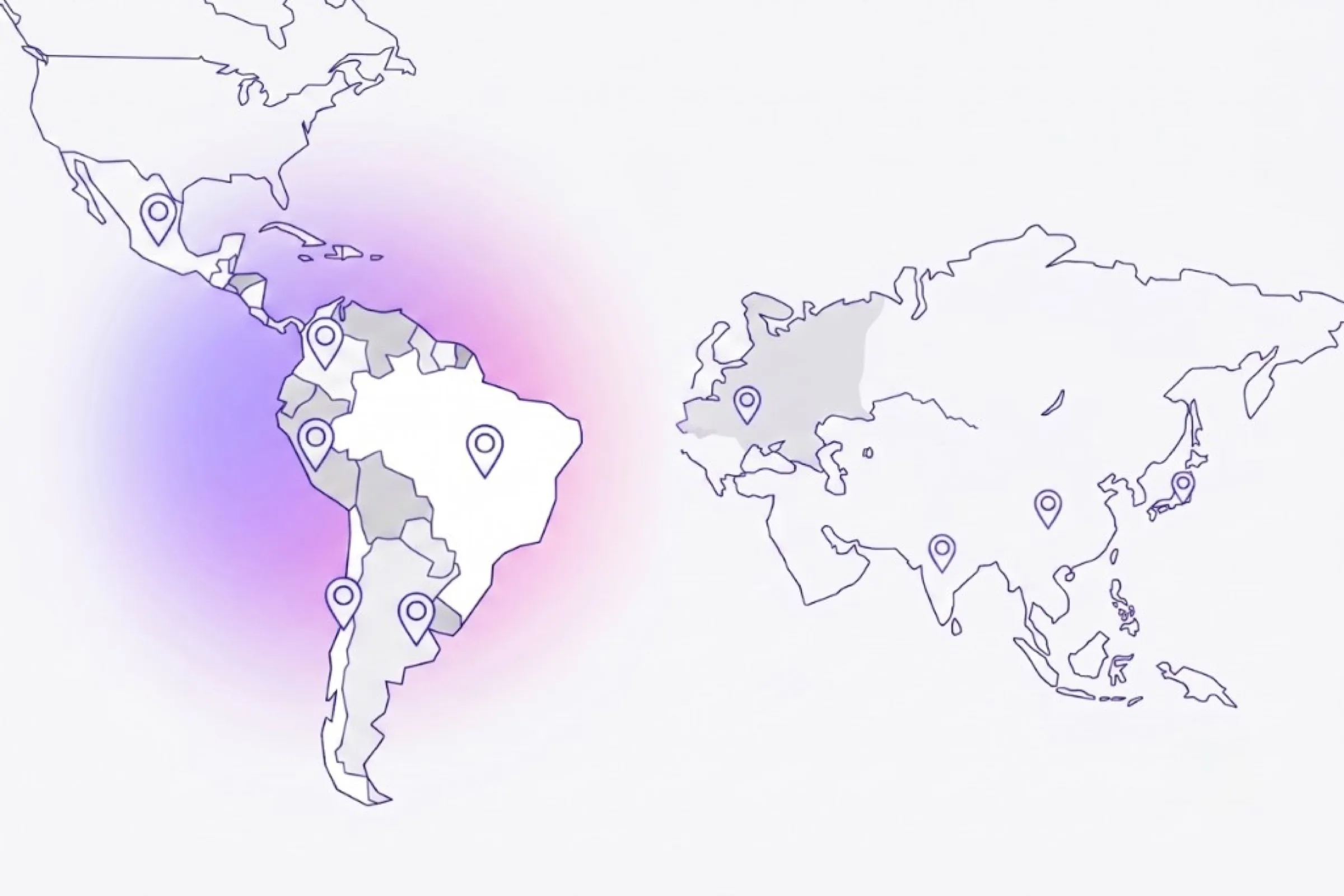
Nearshore staff augmentation means extending your team with professionals in nearby countries that share similar or overlapping time zones. For US companies, nearshore means Latin America (Mexico, Colombia, Argentina, Brazil, Uruguay) and Canada, where the time difference from US headquarters is typically one to three hours. These engineers join standups, sprint ceremonies, and code reviews in real time, integrated into the same repositories and communication channels as the core team.
Nearshore markets typically offer rates 30 to 50% below US onshore equivalents (BLS OEWS, May 2024; Accelerance 2026 Global Software Development Rates Guide). Because they share similar business cultures, communication norms, and often closer regulatory frameworks with the US, collaboration friction is structurally lower than in distant offshore regions.
Offshore staff augmentation: how it works
Offshore staff augmentation involves hiring engineers in distant countries, often on different continents with time zone gaps of 8 to 14 hours relative to US headquarters. Common offshore hubs include India, the Philippines, Vietnam, Eastern Europe (Poland, Romania, Ukraine), and parts of Africa. Headline labor costs are lower than nearshore, and established offshore delivery centers can assemble large teams quickly.
The time zone gap reshapes collaboration. Offshore work typically runs on written specifications, scheduled handoffs, and asynchronous review cycles rather than live interaction. In exchange, startups access very large, specialized talent pools and can design round-the-clock coverage where offshore teams continue work after US teams sign off.
Key differences: nearshore vs offshore for US startups
Time zone overlap and collaboration style
Nearshore LATAM teams operate within one to three hours of US time zones, enabling real-time standups, live pair programming, and same-day feedback loops. Offshore teams in India or Eastern Europe sit 8 to 14 hours away, pushing most interaction toward async workflows, detailed written specs, and overnight execution batches.
The operational difference is not cosmetic. A startup iterating on product in two-week sprints with daily scope adjustments needs to reach engineers during the same working hours. Every handoff that requires an overnight wait adds at least one day of delay to decision cycles.
Cost structure
Offshore staff augmentation delivers the lowest headline labor costs, with most estimates citing 40 to 60% reductions versus US local hiring (Accelerance 2026 Global Software Development Rates Guide). Nearshore staffing provides meaningful but comparatively smaller savings, typically 30 to 50% below onshore rates (BLS OEWS, May 2024; Accelerance 2026), because LATAM economies have higher average salaries than many offshore hubs. However, the real cost comparison should include collaboration overhead: rework from async miscommunication, added management time for written spec cycles, and the retention cost when offshore engineers are harder to keep engaged across a 12-plus-hour gap. When an offshore engineer departs at month nine, the replacement cycle, including new sourcing, weeks of ramp time, and rebuilt project context, typically erases six to twelve months of savings from a lower hourly rate. The headline number is where the cost comparison starts, not where it ends.
Talent pool size and specialization
Offshore hubs have built large talent pools over decades. India's software engineering ecosystem is particularly deep for full-stack, backend, QA, data engineering, and support operations. Nearshore LATAM talent pools are strong but smaller. For commodity roles at volume, offshore has an inherent supply advantage. For senior individual contributors working on ambiguous, high-context product problems, nearshore talent with relevant startup experience and real-time availability is often a better fit.
Cultural and language fit
LATAM engineers, particularly those working with US startups, typically have strong English proficiency and cultural alignment with US business norms: comfort with direct feedback, proactive communication, and autonomous decision-making within scope. Many are also product-minded in the way early-stage US companies need. Product-minded means they do not wait for exhaustive specs before asking a clarifying question. They surface trade-offs during implementation rather than after. They flag when a requirement does not make sense against the broader product goal, instead of building exactly what was written in the ticket. At a growth-stage startup where roadmaps shift quickly and engineering leadership has limited bandwidth to over-specify every task, that instinct is a meaningful force multiplier. It compresses the feedback loop between intent and output, reduces costly rework cycles, and makes individual engineers more effective contributors to product decisions, not just execution resources. This profile is common in LATAM engineers who have worked in or alongside US startup environments and have internalized a bias toward ownership over compliance with process. This reduces the management overhead that offshore teams with more variable communication standards can create. Offshore teams can deliver excellent communication and strong execution when processes are mature and work is well-specified, but the risk of cultural and linguistic friction is structurally higher at earlier product stages, and bridging it requires deliberate investment in documentation, escalation paths, and coordination overhead.
Compliance, legal, and operational risk
Nearshore regions often share closer legal frameworks with the US regarding labor, data protection, and IP. Working with LATAM talent through a platform that acts as Agent of Record (handling payroll, local compliance, and contractor agreements) significantly simplifies this. Offshore staffing in India, Eastern Europe, or Southeast Asia requires careful attention to local labor laws, tax rules, data-protection statutes, and IP assignment to avoid misclassification risk or contractual exposure.
Comparison table: nearshore vs offshore for US startups
Where nearshore LATAM outperforms offshore
Nearshore is the better fit when a startup's product work demands fast back-and-forth, shared context, and access to decision-makers during the same working day. This is particularly true for organizations that rely on daily standups, mid-sprint scope adjustments, and live reviews to align engineering, product, and go-to-market stakeholders.
For early-stage startups building net-new products, nearshore engineers benefit from real-time access to founders and product managers, which reduces rework and compresses feedback loops. When requirements evolve rapidly, as they typically do in pre-Series B product development, the ability to surface a blocking question and get an answer within the hour is a material velocity advantage.
Growth-stage and mid-market companies face a different version of the same problem. As engineering headcount scales and product surfaces multiply, the coordination cost of async offshore handoffs compounds across more engineers, more squads, and more stakeholders. A Series C company running three overlapping product squads cannot absorb overnight delays on high-stakes architectural decisions without slowing the entire release cadence. Companies at this stage often have an existing offshore track for stable or high-volume work and are evaluating whether to build a nearshore layer on top for the product work that needs tighter alignment. That hybrid is frequently the right answer, and it does not require displacing what is already working.
LATAM nearshore is also a stronger fit for core product surfaces, data models, and infrastructure that tie directly into revenue or customer experience. The stakes are too high for overnight communication cycles when a decision about a data architecture or API design has downstream consequences across the entire product.
Where offshore outperforms nearshore
Offshore excels when priorities tilt heavily toward minimizing costs, scaling headcount quickly, or running standardized, well-documented processes. This makes offshore a natural fit for maintenance work, mature backlogs, support queues, QA automation, data labeling, and tasks that can be handed off in clear batches.
Offshore models also support follow-the-sun coverage: tasks pass from US daytime teams to offshore engineers who continue working overnight, which is valuable for 24/7 support or time-sensitive operations requiring continuous progress.
These advantages come with an operating-model cost. Specifications need to be tighter, handoffs cleaner, and governance more structured to keep offshore work aligned with product intent and quality standards. Startups with weak documentation practices or fragmented product ownership will absorb that cost in rework and coordination overhead.
India vs LATAM for US B2B SaaS: a direct comparison
This is one of the most common questions engineering leaders at Series B companies face, particularly when they already have an India team and are evaluating whether to expand it or open a LATAM track.
For a Series B B2B SaaS company with an existing India team, the typical best use of LATAM is not replacement. It is complementary: LATAM engineers own the high-context, iterative product work that benefits from US time zone alignment, while the India team handles maintenance, batch processing, and stable backlogs. This hybrid avoids disrupting existing offshore capacity while unlocking the real-time collaboration layer that drives product velocity.
Hiring integrity risk: why the time zone gap is a verification blind spot
Remote engineering hiring has an identity problem, and the 9 to 13 hour time zone gap that defines most offshore arrangements makes it structurally harder to catch.
Gartner projects that by 2028, one in four candidate profiles globally will be fake. Remote roles are already 10 times more likely to receive fraudulent applications than in-person roles (Huntress, 2025). Engineering is the highest-exposure function: 31% of hiring managers have personally interviewed a candidate later revealed to be using a fake identity, and 35% confirmed that someone other than the listed applicant participated in a virtual interview (Checkr, 3,000 hiring managers, 2025). Seventeen percent of hiring managers have already encountered deepfake technology used to manipulate a video interview (Resume Genius, 1,000 hiring managers, 2025).
The most documented case is state-sponsored: the US Department of Justice has confirmed that more than 300 US companies (including Fortune 500 banks, a defense manufacturer, a major TV network, and Nike) unknowingly hired IT workers linked to the DPRK (North Korea), who used stolen US identities, deepfake video, and laptop farms to conceal their locations and funnel salaries to weapons programs. CrowdStrike recorded a 220% year-over-year increase in DPRK IT worker activity, with 320 incident-response cases in the year ending June 2025. Microsoft tracks this operation under the threat actor designation Jasper Sleet.
This is not a problem unique to one geography. The FBI's updated guidance notes that domestic US-based fraud networks are now active as well. The structural enabler is remote-first hiring with asynchronous communication, not any particular country.
The nearshore LATAM structural advantage here is time zone overlap. When engineers work within 0 to 3 hours of your team, you can:
- Conduct live, unscripted video interviews that expose deepfake artifacts under real-time pressure
- Require spontaneous technical proofs (whiteboard, pair programming, live code review) that defeat proxy and AI-assisted responses
- Maintain daily synchronous touchpoints that surface behavioral discrepancies before they compound
- Onboard with camera-on ceremonies that verify the hired person is the person working
With a 9 to 13 hour gap, most of that verification surface disappears. Async communication means more decisions are made without live observation. Overnight handoffs create windows where identity continuity is unverifiable. You can still hire well offshore, but the vetting and monitoring infrastructure you need is meaningfully higher, not because of where a person is from, but because of how much synchronous signal you lose.
If your engineering work involves sensitive data, regulated systems, or privileged production access, that asymmetry is a risk factor worth pricing into your hiring model.
Decision framework for US startups
The nearshore vs offshore decision maps most cleanly to two questions: how much of your engineering work requires live, bidirectional communication to be done well, and how much does your current product state allow you to fully specify work upfront?
If most of your engineering is exploratory, design-intensive, or cross-functional (touching product, UX, and engineering stakeholders simultaneously), nearshore LATAM is the better fit. If most of your engineering is execution-heavy, well-specified, and could be defined in a thorough ticket or spec doc without live discussion, offshore is viable.
Practical decision steps:
- Audit your current sprint rituals. Count how many decisions per week require a synchronous conversation to resolve. If it is more than five, async-first offshore models will create bottlenecks.
- Map your work types. Separate core product (high context, high stakes) from operational delivery (maintenance, QA, support). Apply nearshore to the former and consider offshore for the latter.
- Assess your compliance exposure. If your product handles sensitive data, operates in a regulated vertical (HealthTech, Fintech), or requires strict IP protection, the compliance simplicity of a LATAM Agent of Record model carries real risk-reduction value.
- Stress-test retention assumptions. An offshore engineer who leaves after eight months costs more than the salary difference when the knowledge transfer and re-hire cycle is included.
Hybrid nearshore-offshore strategies
Many US startups eventually adopt a hybrid model that uses nearshore and offshore where each performs best and orchestrates them as parts of an integrated delivery organization. A common pattern: place core product squads and critical engineering leadership nearshore for maximum collaboration and alignment, while offshore teams handle high-volume, cost-sensitive execution within well-defined modules.
This layered structure allows startups to tune cost, collaboration, and coverage over time. As product complexity grows and strategic stakes increase, the balance typically shifts more toward nearshore; as the product matures and backlogs stabilize, offshore execution capacity can be expanded without sacrificing product velocity.
Why Remotely is built for nearshore LATAM staff augmentation
You choose the engineers. You control compensation. We handle everything else.
Remotely is staff augmentation built for growth-stage US startups. Not a recruitment agency. Not a delivery center. A platform where you find, hire, and manage senior nearshore LATAM developers without the compliance overhead, fee markups, or coordination lag that traditional models add.
We analyzed 25M+ developer profiles across LATAM, screened for experience, open-source code quality, English fluency, and startup mindset, and kept the top 7,000+ in the network. Submit a role and you get interview-ready candidates within 48 hours. 80% of the profiles we present get interviewed, because we screen before you ever open a profile.
The cost-plus model means every dollar of engineer compensation goes directly to the developer. On top of that, you pay a flat monthly management fee per engineer. That fee does not change when you give a developer a raise. No salary-scaling markup, no placement fee, no incentive for us to steer you toward more expensive candidates. You negotiate comp directly. You retain the best talent by actually paying them well.
We serve as the Agent of Record across Argentina, Uruguay, Mexico, Colombia, and the wider LATAM region. Payroll, local compliance, PTO tracking, and equipment procurement are handled. You get one invoice per month and zero administrative overhead. Average contractor tenure is 18 to 24+ months, significantly above the staff augmentation industry norm, because developers who are embedded, fairly paid, and actively supported stay.
Frequently asked questions
Which LATAM countries have the most time zone overlap with US East Coast tech teams?
Colombia (Bogotá, UTC-5 year-round) and Mexico (Mexico City, UTC-6 standard / UTC-5 daylight) provide the tightest overlap with US East Coast teams. Colombia observes no daylight saving time, so it stays 0 to 1 hour behind New York year-round, giving effectively the same working day. Mexico City is 1 to 2 hours behind New York depending on season. Argentina (Buenos Aires, UTC-3, no daylight saving) runs 2 to 3 hours ahead of US East Coast in summer and aligns closely in winter. Uruguay (Montevideo, UTC-3) is in the same band as Argentina. Brazil's São Paulo (UTC-3) adds a similar offset. All five countries support full overlap with US East Coast core hours (9 AM to 6 PM ET), enabling daily standups, live code reviews, and synchronous pair programming without scheduling gymnastics.
How does LATAM time zone alignment with the US compare to India or Eastern Europe?
India Standard Time (UTC+5:30) sits 9.5 hours ahead of US Eastern Standard Time and 10.5 hours ahead of US Eastern Daylight Time. Effective real-time working-day overlap between a New York team and a Bangalore team is typically one to two hours in the early morning (New York) or late evening (Bangalore). Eastern European hubs (UTC+2 in winter, UTC+3 in summer) are 7 to 8 hours ahead of US East Coast, leaving roughly one to three hours of end-of-day overlap if the Eastern European team works late. LATAM, by contrast, delivers 6 to 8 hours of shared working-day coverage with US East Coast teams, enough to run full Scrum ceremonies, unblock dependencies in real time, and maintain the same sprint cadence as the core team. The practical difference is not a minor scheduling adjustment: it is the difference between a synchronous and an asynchronous team model.
Why do US startup CTOs prefer LATAM engineers over Eastern European outsourcing?
Three factors consistently drive the preference. First, time zone alignment: LATAM provides near-full working-day overlap with US teams, while Eastern Europe typically offers one to three hours of late-day overlap, which is insufficient for iterative product development. Second, cultural and communication fit: LATAM engineers in the US startup market tend to have strong English proficiency, direct communication styles, and familiarity with US SaaS company norms, reducing the management overhead that cross-cultural communication can introduce. Third, geopolitical and operational stability: the conflict in Ukraine and ongoing volatility in parts of Eastern Europe have increased continuity risk for startups relying on those regions as engineering hubs, accelerating the shift toward LATAM as a more stable nearshore alternative. Compliance via an Agent of Record model is also more mature and streamlined for LATAM countries than for some Eastern European jurisdictions.
How to outsource software engineering?
Start by clarifying the model, because this shapes everything else. Staff augmentation, where engineers join your team and follow your processes, your tools, and your backlog, is structurally different from managed delivery, where a vendor owns a project and executes independently. For US startups building core product, staff augmentation is almost always the right choice. It preserves your decision-making control, keeps engineers embedded in team culture, and lets you iterate at startup speed. Practical steps: (1) Define the role clearly, including tech stack, seniority level, time zone requirements, and how much real-time collaboration the work demands. (2) Choose a sourcing model: a staff augmentation platform with a pre-vetted nearshore LATAM network, a traditional US recruitment agency, or a project-based firm. (3) Establish an engagement structure: a flat monthly management fee per engineer is the most predictable for ongoing teams and avoids the salary-scaling markups that percentage-based agency fees create. (4) Use an Agent of Record for payroll and compliance if the engineer is in another country. This removes misclassification risk and local labor law complexity. (5) Onboard with the same rigor as an internal hire: system access, documentation, sprint introduction, and a clear 30-60-90 day ramp plan. Engineers treated as team members, not vendors, perform and stay at a different level.
Is it better for a Series B HealthTech company to expand an existing India engineering hub or to build overlapping coverage in Latin America for US time zone collaboration?
For a Series B HealthTech company with US customers and a US-based product team, the answer depends on what the India hub is currently doing well. If the India team handles maintenance, infrastructure support, QA, or well-specified feature work, it is performing the work that asynchronous models support best. Expanding that India hub will scale that type of output. If the bottleneck is product velocity on core clinical or customer-facing features, where ambiguity is high, real-time decisions matter, and delayed feedback cycles slow sprints, expanding the India hub will not solve it. Building a LATAM nearshore track adds the synchronous collaboration layer that India cannot provide structurally. The most effective Series B structure is typically a hybrid: keep and scale the India hub for its current work type, and build a LATAM squad for iterative product development that requires daily alignment with US product leadership. This avoids disrupting existing offshore capacity while unlocking the time zone alignment that drives product velocity on high-stakes work.
India vs LATAM for US B2B SaaS startups: cost, time zone, and hiring velocity?
India offers lower headline rates (roughly 40 to 60% below US onshore) and a very large talent pool for full-stack, backend, and data engineering roles. LATAM rates are typically 30 to 50% below US onshore, so the cost gap is real but narrower than often assumed. The difference closes further when you account for the management overhead that async-first India teams require: tighter specifications, more explicit handoff documentation, and longer feedback loops that add coordination costs not reflected in per-engineer rates. On time zone, the difference is structural: LATAM gives US B2B SaaS teams full working-day overlap; India does not. On hiring velocity, both models can be fast when using a pre-vetted network: Remotely delivers interview-ready LATAM candidates within 48 hours, which is competitive with or faster than typical offshore agency timelines. The most defensible choice for a US B2B SaaS startup that runs sprint-based product development with a US-based product team is LATAM nearshore for core product roles, with India remaining viable for high-volume, well-specified execution tasks.
Why do US engineering teams choose LATAM over India for real-time collaboration?
The core reason is time zone: LATAM engineers share the US working day; India engineers do not. A daily standup at 10 AM ET works for engineers in Bogotá (9 AM), Buenos Aires (11 AM or 12 PM), and Mexico City (8 AM or 9 AM). The same standup at 10 AM ET is 8:30 PM in Bangalore, which is outside normal working hours. Beyond scheduling, real-time collaboration requires being reachable when unplanned questions arise, when a deployment breaks, when a product decision needs quick alignment, and when a pull request comment needs live context. LATAM engineers are available for all of this during the US working day. India engineers are not, and bridging that gap with process, documentation, and tooling adds overhead that many US startup teams are not equipped to absorb while moving fast. Cultural fit compounds the advantage: LATAM engineers working with US startups tend to communicate proactively, escalate blockers quickly, and operate with the startup-native autonomy that US product leaders expect.
Top platforms for hiring offshore engineers?
Platforms fall into two structural categories, and the distinction matters more than the specific name. The first is a talent marketplace: you search a pool, shortlist candidates, close the hire, and take on all compliance, payroll, and contractor management yourself. These work for companies with strong internal HR and legal infrastructure who want maximum flexibility. The second is an Agent of Record platform: the platform handles payroll, local labor compliance, and ongoing retention operations, while you own the day-to-day engineering relationship. This model removes the administrative and legal overhead that international contractor hiring requires and is the better fit for growth-stage startups without dedicated global HR infrastructure. Remotely is built on the Agent of Record model specifically for nearshore LATAM: 7,000+ vetted engineers, 48-hour matching, flat monthly management fee that does not scale with salary increases, and structured retention operations that produce 18 to 24+ month average contractor tenure. The question to ask any platform before signing: do you own compliance and payroll, or does that land on me?
How to find reliable offshore developers?
Reliability in offshore developers comes from two things: upfront vetting quality and ongoing retention infrastructure. On vetting: look for platforms that screen on both technical skills and communication quality, test in the actual tech stack you use, and assess startup-fit signals like async communication, initiative, and comfort with ambiguity. Self-reported profiles on generic freelance marketplaces tend to overstate both skills and reliability. On retention: developers who are paid fairly, embedded in team culture, and given a career growth path stay longer and maintain higher engagement. Platforms that treat compensation as a pass-through (cost-plus) and run structured retention checkpoints tend to produce significantly higher tenure than those that optimize for volume placement. Before signing with any platform, ask for average contractor tenure data, ask what retention operations they run after placement, and ask how they handle a performance or fit issue without requiring you to re-hire from scratch.
Sources
Gartner: Mitigate Rising Candidate Fraud, HR Dive coverage · Huntress: AI-Enhanced Candidate Fraud · Checkr: The Hiring Hoax, 2025 · Resume Genius: AI's Impact on Hiring, 2025 · DOJ: DPRK Remote IT Worker Actions · CrowdStrike: 2025 Threat Hunting Report · Microsoft: Jasper Sleet · FBI IC3: DPRK IT Worker PSA · TCS Q4 FY25 Fact Sheet · Infosys Q4 FY25 attrition · Wipro Q4 FY25 attrition · SIA Staffing Industry Benchmarks 2025 · SHRM: The Real Costs of Recruitment, 2022