.svg)
.svg)


92% of developers now use AI coding assistants at least monthly. 80% of new GitHub users adopt Copilot in their first week. GitHub recorded 986 million code pushes in 2025, up 25% year over year. Developer output is at record highs, and AI is not slowing it down. It is accelerating it. The bottleneck has moved. It is no longer who can write the code. It is who can frame the problem clearly enough for an agent to execute it, direct that agent without losing judgment, and verify the output before it reaches production. That single shift changes who you should hire, how your interview loop should be designed, and what the word "senior" actually means when implementation is no longer the constraint.
Those numbers come from the GitHub Octoverse 2025 report and exclusive DX data presented at The Pragmatic Summit in San Francisco in February 2026, where Martin Fowler and Kent Beck both said they had not seen the industry move this fast in their combined 50 years in software. The Octoverse research also documents what that acceleration produced at the identity level: advanced AI users stopped asking "if I am not writing the code, what am I doing?" and arrived at a clear answer. They became the directors of the work, setting architecture, constraints, and standards, then delegating implementation and spending primary effort on verification. The Pragmatic Summit put a structural number on it: teams are moving from two-pizza (6 to 10 people) toward one-pizza (3 to 4 people), with the same or greater output. Output is compounding. What that output demands from the engineers producing it is not.
This is not a tooling change. It is a category change. The engineering role is being compressed upward, toward problem framing, architecture, and verification, and the hiring loop that does not account for that is already selecting for the wrong thing.
Why the old hiring loop is now misaligned with the work
Most engineering interview loops still optimize for the artifact AI has commoditized: the live coding round, the time-boxed algorithm puzzle, the take-home that measures keystrokes per hour. A peer-reviewed study published at the 2025 ACM International Conference on the Foundations of Software Engineering, "What do professional software developers need to know to succeed in an age of Artificial Intelligence?" (Matthew Kam et al., Google), interviewed 21 developers at the cutting edge of AI usage and mapped 12 work goals, 75 tasks, and the skills needed at each step. The study's conclusion is direct: the highest-leverage engineering skills are now meta-skills sitting on top of foundations, not the foundations themselves.
That maps cleanly to a real risk the same paper calls out directly: deskilling. Developers who outsource tasks they do not fully understand lose the ability to catch errors in AI output. That is the exact moment a hiring loop matters: a hire who cannot evaluate AI output will silently ship the failures. A hire who can will catch them before they touch production.
If your interview pipeline does not test for problem framing, agent direction, and verification, you are measuring the wrong thing. The next four sections give you a framework you can actually screen for.
The four skill domains that now define a hireable engineer
The ACM study collapses the AI-era developer skill set into four domains, deployed across a six-step task workflow. Hiring loops should explicitly score for each.
The point of the four-domain frame is not to add four more interview rounds. It is to make sure each round you already run is testing one of these, on purpose, and that the score sheet at the end is balanced. Loops that score 90% on core software engineering and ignore generative AI fluency, adjacent engineering, and adjacent non-engineering skills are how teams end up with senior-titled engineers who cannot direct an agent or close a stakeholder conversation.
AI fluency maturity model and where to hire on it
GitHub's qualitative research with advanced AI users describes a four-stage fluency curve. Most candidates today sit at AI Skeptic or AI Explorer. Almost all of your leverage comes from AI Collaborator and AI Strategist.
The market is already pricing this. The jump from Collaborator to Strategist is where compensation premiums and offer competition concentrate, and where hiring interviews are being redesigned to probe. If your interview process cannot distinguish an AI Explorer from an AI Collaborator, you are paying senior rates for autocomplete users.
The three dimensions a great engineering hire can operate across
Skills do not live in a flat list. GitHub's 2025 research organizes them into three dimensions, and the best engineers move across all three in the same week.
Understanding the work
This is where AI fluency, fundamentals, and product thinking sit together. AI fluency is built only through relentless daily use, so interview questions about "have you used Copilot" mean almost nothing. Questions about "walk me through a recent loop where the model was wrong and how you caught it" mean everything. Fundamentals matter not because the engineer will write them by hand, but because they will be the human review pass on AI output that looks right and is not.
Directing the work
This is the new center of gravity for the role. Senior engineers used to be defined by what they could implement. They are now defined by how clearly they can frame a problem, break work into meaningful units, articulate constraints and success criteria, and hand the parts that should be handed off to agents while keeping the parts that require judgment. Architecture and systems design, which used to be a late-career skill, has moved earlier in the seniority curve, because once implementation is delegated, the scaffolding is the contribution.
Verifying the work
Many senior engineers now report spending more time verifying than generating, and consider this the correct allocation of effort. Code review, security scanning, behavior validation, and assumption checking are no longer end-of-sprint hygiene. They are a continuous practice. A hire who cannot run that practice will let AI-generated regressions through. A hire who can run it well becomes a multiplier on every junior and mid-level on the team.
Where the hiring market is breaking right now
New graduates onboard with AI tools natively. Senior engineers have architectural judgment AI cannot replicate. Mid-level engineers (3 to 8 years experience) are being compressed from both directions, and engineering leaders describe it as a "quiet crisis."
This was one of the most candid findings from The Pragmatic Summit, surfaced publicly by Gergely Orosz in The Pragmatic Engineer. The advice given inside engineering leadership rooms was blunt: mid-level engineers need to deliberately accelerate toward architecture and verification skills, not continue optimizing for implementation speed. The market is no longer paying a premium for "fast typist with three years of React."
For hiring managers, this has two operational consequences:
For talent partners, the implication is sharper. The right answer is not "ship more mid-levels." It is "ship a smaller number of judgment-heavy seniors who close the gap between intent and shipped product."
Teams are shrinking, output is growing
A Head of Engineering at a 200-year-old agricultural company stated at the same Pragmatic Summit, quoted by Orosz: "We are already seeing the end of two-pizza teams (6 to 10 people). Our teams are slowly becoming one-pizza teams (3 to 4 people) across the business." Atlassian's CTO, in the same source, confirmed that teams at Atlassian are not getting smaller but are producing 2 to 5x more, with creativity, not just efficiency, measurably up.
This is why hiring standards have to rise. A small team can now produce more than a large team could a few years ago, but only if every person on it can operate at that level. Teams that raise the bar on who they hire take advantage of this. Teams that keep optimizing for code volume do not.
The data backs this up. The MIT GenAI Divide: State of AI in Business 2025 studied roughly $30 to 40 billion in enterprise GenAI spending and found that 95% of organizations are getting zero measurable return, while just 5% are generating millions in value. The authors are direct about why: the divide is not about which tools you buy. It is about how your organization is structured and how well your people are able to use them. Organizations that AI multiplies are already well-run. It does not rescue ones that are not. Hiring is one of the clearest levers you have to determine which side of that divide your team ends up on.
TypeScript at #1
In August 2025, TypeScript overtook Python and JavaScript to become the #1 most-used language on GitHub, adding over 1 million contributors in a single year (+66% YoY). The reason is not a framework trend or developer preference shift. It is a direct consequence of how AI writes code: 94% of LLM-generated compilation errors are type-check failures. When AI generates code at scale, you need the compiler to catch what the model missed. Types become the safety net that makes AI-assisted development actually workable. Every other typed language followed: Luau grew +194% YoY, Java, C++, and C# all accelerated.
The hiring signal here is precise. A candidate who understands why TypeScript is winning in an AI-augmented world is demonstrating something beyond language preference. They understand the new failure modes, where errors come from, and how to build systems that stay stable when code volume scales beyond what any single person reviews. A candidate who treats it as a stylistic choice probably has not thought carefully about what changes when the model is writing half the code.
TypeScript fluency does not need to be a hard filter. It is a reliable proxy for whether a candidate is reasoning about the right constraints.
What hiring leaders should change this quarter
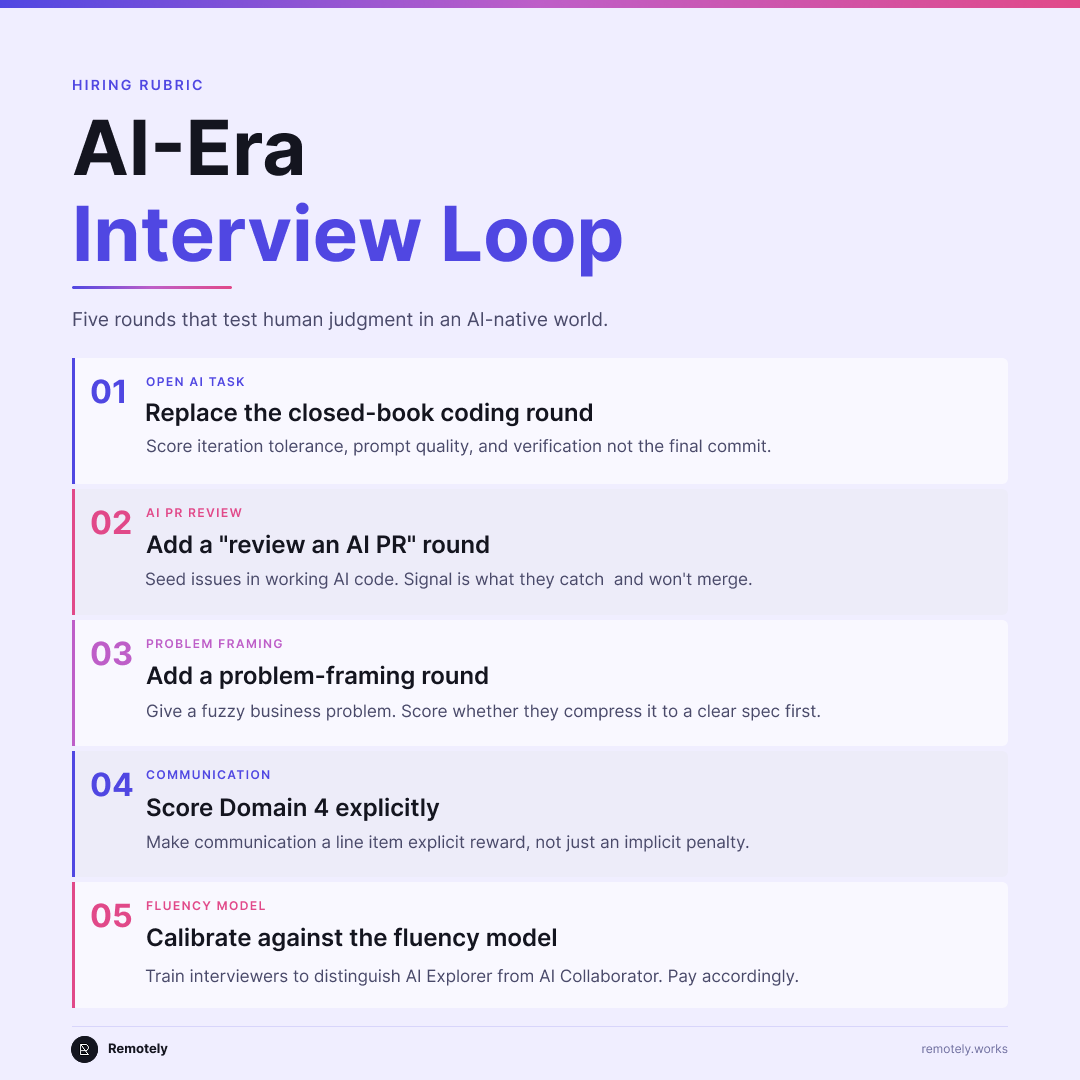
Most hiring loops need five targeted updates to reflect how engineering work has changed. Each one maps directly to a domain or dimension covered in this article.
The irreducible human stack you should be hiring for
A set of capabilities AI structurally cannot replicate in the engineering function. These should appear in every senior hire's score sheet.
The profession is not ending. It is being compressed upward, toward judgment, architecture, and accountability. Any engineer, hiring manager, or talent platform that has not yet internalized this will be systematically misaligned with where the market is heading.
Building toward the AI-fluent engineering team
There is no single path to getting this right. The engineering community is actively working through it: developer communities organizing around AI tooling, open-source groups sharing prompt engineering practices, companies like Cursor, GitHub, and Atlassian publishing internal playbooks on how their own teams adapted. CS programs are being updated. Internal upskilling programs are being built. The field is catching up quickly, and no single vendor owns the answer.
There are a few concrete things you can do regardless of how you hire:
How Remotely approaches AI fluency
At Remotely, we made a specific bet on this: AI fluency is a development problem as much as it is a hiring problem. That means two things run in parallel.
On the vetting side, Remotely screens senior engineers explicitly for AI fluency and practical judgment, not just framework coverage. The 7,000+ developer network is concentrated at IC5 to IC6, the seniority band where AI leverage compounds rather than gets wasted. Vetting criteria assess whether candidates can direct agents, evaluate output, and operate across all three dimensions: understanding the work, directing the work, and verifying the work. Startup mindset is a hard filter, not a soft preference, because growth-stage teams need engineers who treat product outcomes as their own.
On the development side, Remotely provides continuous upskilling in the newest AI tools and mentoring as part of the ongoing engagement. Engineers in the network stay updated on tooling shifts so their fluency grows alongside the market, not behind it.
Part of making that work is being transparent about compensation from the start. That kind of ongoing investment in the developer network only works when compensation is transparent. Operating on a cost-plus model makes that possible: you see exactly what the engineer earns, what the margin is, and no hidden markup sits in between. That matters here because it lets you reward the engineers whose AI fluency is actually moving the needle, something you cannot do when the numbers are opaque. If you are still working out which engagement model fits your team, the staff augmentation vs EOR vs direct hire breakdown is a good place to start.
If you want support designing your own AI-era evaluation rubric, access candidates from the vetted network, or talk through what an AI Collaborator or AI Strategist hire looks like in practice for your team, get in touch with Remotely.
Frequently asked questions
If AI can generate code that contains no errors and does what you say, then what really matters?
Code generation is not the bottleneck anymore. Even when AI output compiles, the highest-leverage work is problem framing, directing agents with clear constraints, and verifying output before it ships. A 2025 ACM FSE study maps this into four skill domains and warns about deskilling: engineers who delegate work they do not understand lose the ability to catch AI errors, which is where production damage happens. What matters now is judgment across three dimensions: understanding the work, directing it, and verifying it continuously, not typing speed.
What does it really mean to be a "senior" engineer when AI is doing most of the typing?
Senior engineers are becoming creative directors of code: they set direction, architecture, constraints, and standards, delegate implementation to agents, and spend primary effort on verification. GitHub's 2025 research with advanced AI users describes this identity shift explicitly. In hiring terms, senior means AI Collaborator or AI Strategist fluency, not just years of experience or frameworks on a resume. Architecture and systems design moved earlier in the seniority curve because once implementation is delegated, the scaffolding is the contribution.
What skills does AI not replace for software engineers?
Five capabilities recur across the ACM study, GitHub's identity research, and engineering leadership consensus: ethical reasoning and accountability, ambiguity resolution, cross-domain knowledge, trust and judgment under uncertainty, and organizational and communication skills. AI also does not replace the core engineering foundations needed to evaluate its output. Algorithms, data structures, and system behavior are the bedrock that lets you catch hallucinations and subtle regressions in code that looks correct. The fourth skill domain in the ACM framework (communication, product thinking, domain expertise, ethical reasoning) is entirely human-led.
How are companies changing the way they interview software engineers now that AI can help with coding problems?
Leading teams are redesigning loops away from closed-book coding puzzles and toward observable judgment. The highest-leverage changes in 2026: run one open AI-assisted task and score iteration and verification, not the final commit; add a "review an AI PR" round with seeded errors; add a problem-framing round before system design; score communication, product thinking, and ethical reasoning as explicit rubric items; and train interviewers to distinguish AI Explorer (autocomplete users) from AI Collaborator on the AI fluency model. The goal is not more rounds. It is balanced signal across four skill domains instead of over-weighting keystroke speed.
What skills still distinguish strong engineers when AI handles most of the implementation?
Strong engineers operate across three dimensions at once: understanding the work (AI fluency plus fundamentals plus product thinking), directing the work (problem framing, architecture, delegation to agents), and verifying the work (continuous code review, security checks, behavior validation). The ACM FSE 2025 framework adds four domains that distinguish top performers: effective generative AI use, core software engineering, adjacent engineering (DevOps, security, cloud, testing), and adjacent non-engineering skills. In practice, the gap shows up between AI Explorer engineers who treat AI as autocomplete and AI Collaborator or AI Strategist engineers who co-create through iterative loops and own outcomes end to end.
How do you evaluate AI fluency in software engineers?
Use GitHub's four-stage fluency model as a scoring lens: AI Skeptic, AI Explorer, AI Collaborator, and AI Strategist. "Have you used Copilot?" is a weak signal. Strong signals include: walk me through a recent loop where the model was wrong and how you caught it; an in-interview AI-assisted task where you score prompt quality, iteration tolerance, and verification, not the final diff; and a review of AI-generated code with planted bugs to test whether the candidate explains what they would not merge. Hire for AI Collaborator or above for roles where AI leverage determines team velocity. Reserve AI Strategist for premium scope owners who orchestrate multi-agent workflows.
What does a good technical interview look like in 2026?
A strong 2026 loop tests judgment, not typing speed, with AI present where appropriate. A practical structure: one open AI-assisted build or debug exercise scored on iteration and verification; one "review an AI-generated PR" round with seeded security, logic, or type errors; one problem-framing round that compresses a fuzzy business request into a tight spec before architecture; one system design or architecture conversation; and explicit scoring on communication, product thinking, and ethical reasoning. Balanced scorecards across all four ACM skill domains beat loops that spend 90% of signal on algorithms alone. Teams that skip the verifying-the-work dimension hire engineers who pass fundamentals and still ship AI-generated regressions.
How do you define senior vs mid-level engineer in 2026?
Title and years of experience are unreliable proxies in the AI era. Engineering leaders at The Pragmatic Summit (February 2026) describe a "mid-level squeeze": new graduates onboard with AI natively, while true seniors have architectural judgment AI cannot replicate. Mid-level engineers (roughly 3 to 8 years) who optimized for implementation speed without system-level authority are compressed from both directions. Define senior in 2026 as AI Collaborator or AI Strategist fluency plus evidence across all three dimensions, especially directing the work and verifying the work. Define mid-level as solid execution with growing framing and review skills, but not yet carrying system boundaries, tradeoffs, and team leverage independently. Calibrate with observable rubrics, not resume keywords.
What to do next?
If your engineering team is hiring in the next two quarters and your interview loop has not been updated for AI-era work, the highest-leverage move is to redesign one round before the next pipeline opens. Start with the "review an AI PR" round, score it against the four domains, and watch how quickly your signal sharpens.
For a country-by-country look at where senior LATAM engineering talent is concentrated, including salary data by country and seniority level, see the nearshore LATAM complete guide.
Sources
GitHub Octoverse 2025 · ACM FSE 2025 · The Pragmatic Engineer, Feb 2026 · The Pragmatic Engineer, Apr 2026 · InfoQ, Mar 2026 · DX at The Pragmatic Summit, Feb 2026 · MIT NANDA, GenAI Divide, Jul 2025