.svg)
.svg)


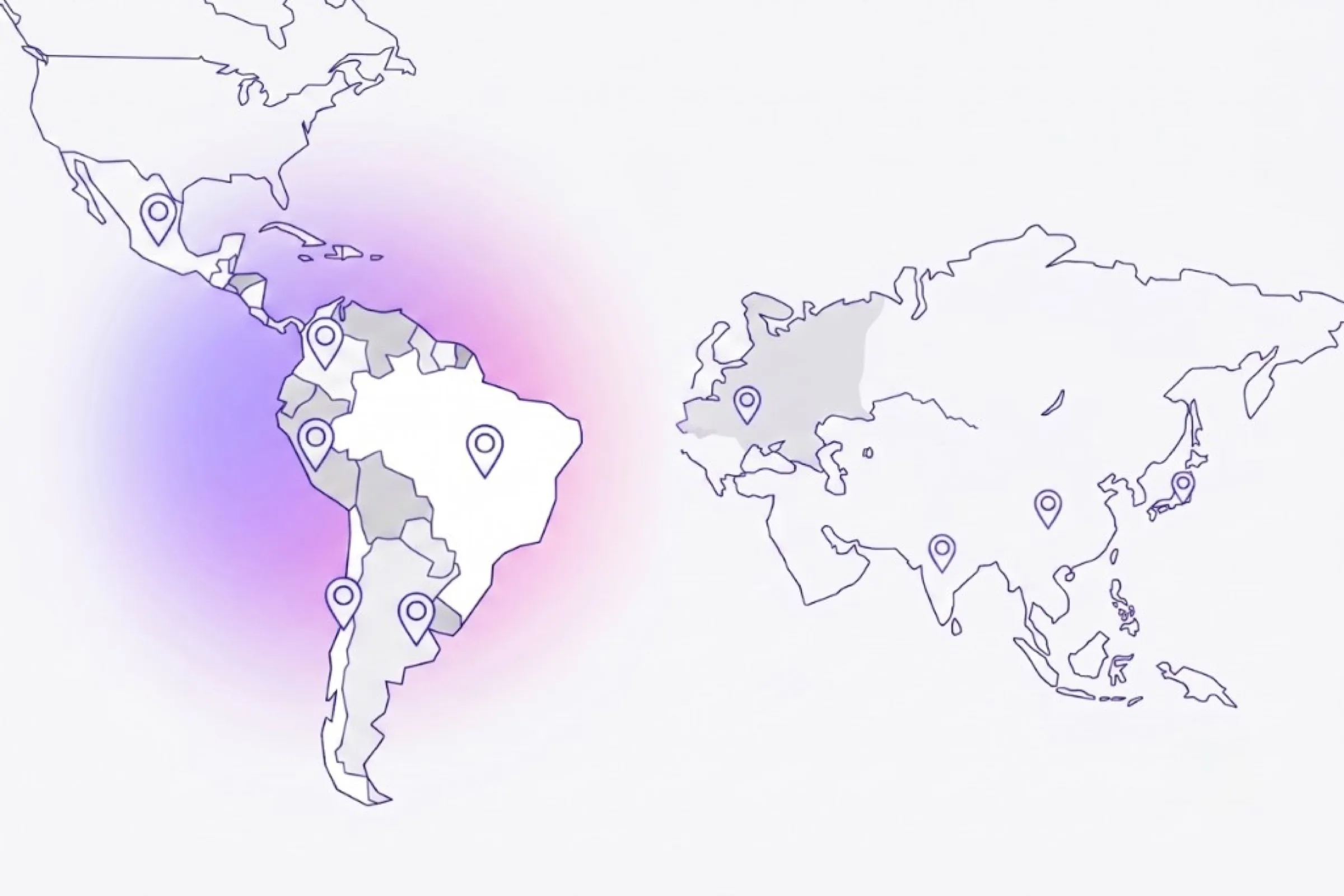
The question isn't whether to hire engineers outside the US. That math is settled. The question is where -- and for US-based startups, nearshore LATAM keeps winning the argument.
Real-time collaboration in overlapping time zones. Deep technical talent pools across six countries. Senior engineers earning $60-100K instead of $150-200K. And a startup ecosystem that's producing developers who've built products at Nubank, MercadoLibre, Rappi, and Globant -- not just engineers who write code, but engineers who understand how to ship.
This is the guide for CTOs and engineering leaders evaluating nearshore LATAM for the first time -- or comparing providers after a bad experience with the traditional model. It covers the full decision: which countries, what it costs, how engagement models differ, and which platforms actually deliver. If you're a growth-stage startup scaling engineering, this is the single resource you need.
The short answer: For most US startups, nearshore LATAM offers the best balance of talent quality, cost efficiency, and real-time collaboration. The strongest approach is country-agnostic -- hire the best engineers across the region rather than concentrating in a single market. Brazil has the largest talent pool, Argentina the strongest English proficiency, Mexico the closest time zones, Colombia the best value on Eastern time. A good staffing partner lets you hire across all of them without you managing the complexity. This guide breaks down all of it with real numbers.
Why Nearshore LATAM -- Not Offshore, Not Domestic
Three options exist for building an engineering team outside your local market: nearshore (LATAM), offshore (India, Philippines, Eastern Europe), and domestic (US-based remote). Each has trade-offs. But for growth-stage US startups, nearshore LATAM wins on the combination of factors that actually determine whether a remote engineering team succeeds.
Where nearshore doesn't win: If minimizing cost per engineer is the only priority, offshore is cheaper. If you need on-site engineers, domestic is the only option.
But for the typical growth-stage use case -- building a 5-25 person engineering team as an extension of your US team -- nearshore LATAM is the strongest option.
Wonderschool's experience illustrates this directly. Their CTO replaced a 20+ person offshore team with 10 nearshore LATAM engineers through Remotely -- and gained velocity. Deployment frequency increased 30%, PR throughput increased 30%. His assessment: "You could close your eyes and not tell the difference between a candidate from LATAM and one from the U.S. or Canada."
For more on time zones, see how LATAM time zones align with the US.
Country-by-Country Breakdown
Not all LATAM countries are interchangeable. Here's what you need to know about the six primary markets.
Brazil
Talent pool: 500,000-630,000 software developers (Statista, BEON.tech). Largest in LATAM. 3rd largest open source contributor globally.
Tech stacks: Java/Spring Boot, JavaScript/TypeScript, React, Node.js, Python. Deep fintech and e-commerce expertise.
Salary range: $60-100K/year (IC4-IC5). Median $72K senior, $85K lead.
Time zone: BRT (UTC-3). 1-2 hours ahead of US Eastern.
English: Tech professionals typically B2-C1. Remotely screens for B2+ minimum.
Ecosystem: Most mature in LATAM. Nubank, iFood, Stone, VTEX, EBANX.
Key consideration: Senior engineers prefer PJ (contractor) structure for tax advantages. CLT employment narrows the senior pool and adds 30-40%+ employer costs.
Argentina
Talent pool: 115,000-141,000 software developers (Statista, CESSI). Broader tech workforce of 490,000+.
Tech stacks: JavaScript/TypeScript, React, Node.js, Python. Home to Auth0, Globant, MercadoLibre.
Salary range: $55-90K/year (IC4-IC5). Top talent reaches $70-100K.
Time zone: ART (UTC-3). Same as Brazil.
English: Best in LATAM. EF EPI #1 in the region (score: 562).
Ecosystem: MercadoLibre, Globant, Auth0 (acquired by Okta for $6.5B), Despegar.
Key consideration: Currency reforms in 2025 moved to managed float. USD contracts standard. Staffing partner handles complexity.
Mexico
Talent pool: 220,000-371,000 software developers (Statista; Mexican government Q1 2025).
Tech stacks: Top 3 for most languages. JavaScript, Python, Java, .NET, mobile.
Salary range: $55-95K/year (IC4-IC5).
Time zone: CST/MST. Same as US Central/Mountain. Zero offset.
English: Moderate and improving. Stronger in Monterrey and Guadalajara.
Ecosystem: Kavak ($8.7B), Bitso, Clip, Stori, CLARA.
Colombia
Talent pool: 62,000-165,000 developers (Statista, TurnKey). Growing rapidly.
Salary range: $50-85K/year (IC4-IC5). Most cost-competitive of the top four.
Time zone: COT (UTC-5). Same as US Eastern.
Ecosystem: Rappi is the flagship unicorn. Bogota and Medellin are primary hubs.
Chile
Talent pool: 123,000+ on LinkedIn. Well-educated, technically strong.
Salary range: $60-95K/year (IC4-IC5).
Time zone: CLT (UTC-4/UTC-3). 1-2 hours ahead of US Eastern.
Best for: Specialized roles (cybersecurity, compliance). Complementary hires.
Uruguay
Talent pool: 26,000+ on LinkedIn. Smallest market, outsized quality.
Salary range: $60-95K/year (IC4-IC5).
Time zone: UYT (UTC-3). Same as Argentina and Brazil.
Best for: Individual senior hires, especially fintech.
A Note on Venezuela
Venezuela has skilled engineers, but banking and compliance risks make it impractical. US banks under AML and BSA regulations routinely block transfers. Venezuela's financial landscape changes rapidly, making long-term commitments risky.
Practical takeaway: Strong Venezuelan talent is often found in Colombia, Chile, Argentina, and Uruguay. Hire through their country of residence.
Don't Pick a Country. Pick the Best Engineers.
The best approach is country-agnostic. Hire the strongest engineers across LATAM. A staffing partner with coverage across all six countries lets every role get matched from the widest possible talent pool.
Engagement Models for Nearshore Hiring
For most growth-stage startups, staff augmentation is the right starting point. See the full engagement model comparison guide.
Platform Comparison: Nearshore LATAM Providers
If you're hiring nearshore LATAM engineers, these are the platforms you'll encounter. The differences are structural -- not just branding.
How to read this table: These platforms solve different problems. If you need a full-service partner that handles sourcing through retention with transparent pricing, Remotely is built for that. If you have candidates and need compliance infrastructure, Deel solves that. If you want to source from a marketplace and manage everything yourself, Near or Revelo are options. The key question is how much of the hiring and management lifecycle you want to own vs outsource -- and whether you want to see what your developer actually earns.
See also: nearshore talent marketplaces compared and job boards for nearshore hiring.
What Nearshore Hiring Actually Costs
Salary ranges by seniority
Salary ranges by role
Source: Remotely Works 2026 Salary Guide. IC4 and IC5 represent 93% of active contractors.
How to Evaluate a Nearshore Partner
Before signing:
- Do they operate in LATAM specifically?
- Can you interview and select candidates yourself?
- Do you see the developer's actual compensation -- and can you control it directly (raises, bonuses, equity) to reward performance?
- Cost-plus or markup pricing?
- How fast to matched candidates? (Target: 48 hours)
- How large is the vetted talent pool?
After the first hire:
- Who handles payroll, compliance, and benefits?
- What's the replacement guarantee?
- Is there ongoing retention infrastructure?
- Can developers receive equity, bonuses, raises directly from your company?
- Is there a tech platform for visibility?
- Can they scale from 3 to 25+ engineers?
- Do customers come back? Azra Games' CTO chose Remotely twice.
Frequently Asked Questions
What is nearshore software development?
Hiring developers in nearby countries with overlapping time zones -- for US companies, that's Latin America. Key countries: Brazil, Argentina, Mexico, Colombia, Chile, and Uruguay.
How much does it cost?
Senior engineer (IC4): $60-84K/year plus management fee. Lead (IC5): $75-105K/year. Backend median $84K, full-stack $80K, DevOps $96K.
Nearshore vs offshore?
Time zones, communication, collaboration quality. Nearshore: 0-3 hour offset. Offshore: 10-12 hours off. Nearshore wins for real-time collaboration.
Best LATAM countries?
Brazil: largest pool. Argentina: best English. Mexico: closest time zones. Colombia: best value on Eastern time. Hire across the region.
Staff aug vs outsourcing?
Staff aug: developers embed in your team. Outsourcing: agency delivers a deliverable. Staff aug costs less at scale and retains better.
Can they work US hours?
Yes. 0-3 hour offset. Mexico = US Central/Mountain. Colombia = US Eastern. Brazil/Argentina = 1-2 hours ahead.
Risks?
Currency volatility (mitigated by USD contracts), legal complexity (mitigated by partner), talent competition, infrastructure variability outside major hubs.
How long to hire?
Staff aug partner: 48 hours to matched candidates, 1-3 weeks to start. Traditional recruiting: 4-8 weeks.
The nearshore LATAM market is large, growing, and well-understood. Hire for talent, not geography.
See how Remotely's cost-plus model works. Compare platforms. Explore time zones.
Data sources: Remotely Works 2026 Salary Guide. EF English Proficiency Index 2025. Statista, BEON.tech, Mexican Secretariat of the Economy, CESSI/Argencon, TurnKey, LinkedIn, GitHub Innovation Graph.